In the final seconds of the Tu-154M flight over Smolensk North airfield on April 10, 2010, the aircraft was in the following configuration:
Mass: approx. 76,000 kg
Flaps: 36° (landing configuration)
Landing gear: deployed
Forward velocity: ~270 km/h (~75 m/s)
Vertical descent speed: ~7 m/s
Thrust: engines at idle (~40 kN total), beginning to spool up
Time required to reach full take-off thrust: ~8.5 seconds (per D-30KU-154 engine specs)
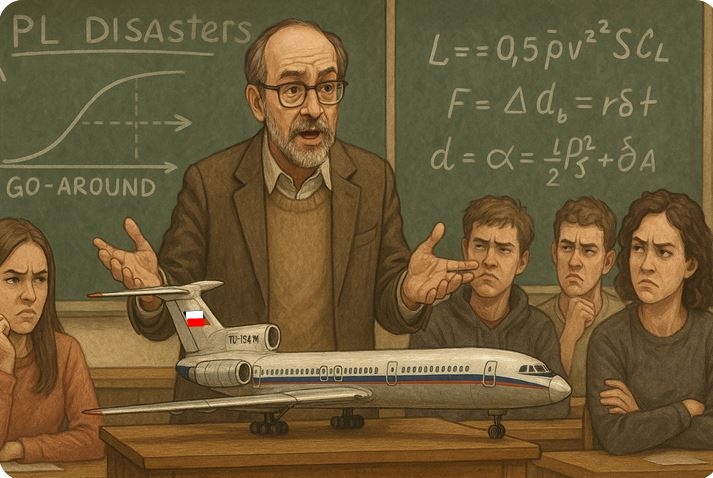
In such a situation, pilots may instinctively try to pull back and raise the nose, increasing the angle of attack (AoA) to stop the descent.
This intuitive reaction is aerodynamically dangerous under these conditions, and can quickly lead to stall and loss of control.
Why increasing angle of attack without sufficient thrust is dangerous
Drag increases dramatically:
As AoA increases, induced drag rises non-linearly with the square of lift coefficient (CLC_LCL),
The aircraft demands even more thrust, which it does not have at that point.
Approaching the critical AoA — stall risk:
Beyond ~16–18°, airflow separates from the wing’s upper surface,
Lift collapses, and the aircraft may enter a deep aerodynamic stall.
Loss of pitch control:
In deep stall, elevator effectiveness is reduced,
Tu-154M has a T-tail configuration, increasing the risk of „deep stall”, where the horizontal stabilizer is immersed in turbulent wake behind stalled wings.
Post-stall trajectory is ballistic:
The aircraft becomes nearly uncontrollable in pitch,continues on a steep descending arc with no meaningful aerodynamic recovery unless large altitude and thrust margins are available — which they weren’t.
Continues on a steep descending arc with no meaningful aerodynamic recovery unless large altitude and thrust margins are available — which they weren’t.
The 2010 Moscow simulator experiment: unrealistic success?
In July 2010, the Interstate Aviation Committee (MAK) conducted a go-around simulation on a full-flight Tu-154M simulator in Moscow. Their reported results showed:
Aircraft successfully transitioned into a climb.
Sink rate arrested within 19–23 meters,
Maximum load factor: up to 1.5 g,
But serious doubts exist about the realism of this simulation:
1. Thrust ramp-up may have been artificially accelerated:
Real D-30KU-154 engines require ~8.5 seconds from idle to take-off thrust,
The simulator may have implemented idealized (faster) thrust response for testing purposes.
2. Load factors in the simulation exceeded those recorded in the actual flight:
Flight data recorder (FDR) from Smolensk flight: max 1.35 g,
3. In the simulation, flaps were retracted or repositioned (e.g., 36° → 28°):
Without this change, drag remains too high for successful climb-out.
In the real flight, no such configuration change occurred — no command, no attempt.
Conclusion for investigators and analysts
Increasing the angle of attack under low thrust and high drag conditions does not stop descent — it accelerates stall,
In Tu-154M, this leads to rapid loss of lift and control, especially with gear/flaps extended,
The 2010 Moscow simulation, although technically interesting, used flight parameters not observed in the real Smolensk flight.
Therefore, its conclusions — particularly the minimal sink rate of 19–23 meters — cannot be considered physically representative of what was possible in the actual aircraft’s state.
Summary:
The combination of low initial thrust, landing configuration, and attempting to pitch up aggressively would have pushed the Tu-154M into a deep stall, not into a climb.
Realistic simulation shows minimum altitude loss of ~100 meters, unless flaps were retracted and full thrust already available.
Any attempt to claim otherwise must justify how thrust, drag, load factors and configuration handling in the simulator reflect actual aircraft limitations — which is highly questionable.
In a hurry..— What to do? What to do? How to show that this was not a Special Operation, but a CFIT — the fault of the Polish pilots…
The Russians were eager to publish and imprint their (fabricated) version of events in the public consciousness as quickly as possible. Despite their well-known mastery in manipulating, deceiving, and concealing the truth, they still made a critical mistake.
They brought the fabricated trajectory of the final segment of the flight too far down into the ravine… This is clearly visible on the diagram.
But this becomes clearly visible only when you put on the diagram from the Preliminary Report the points whose coordinates are given in the Report. I did this…
— And this is how it would look in reality: the aircraft would have hit the ground while descending…
The MAK/Russians wanted to cover up this blunder, so quickly — in July 2010 — they arranged a staged demonstration, a manipulation, on a simulator in Moscow, into which they easily drew the naïve Dr. Edmund Klich, who took part in this experiment as if it were for Sheremetyevo airport… and noticed nothing suspicious.
The Russians supposedly performed on the simulator a go-around maneuver “like in Smolensk,” with “parameters like in Smolensk,” but in reality they hid some of the parameters (for example, engine power setting) and ignored the fact that in Smolensk the terrain was rising — and quite noticeably. In the simulator experiment the terrain was… flat.
And so, in the Tu-154M simulator experiment, it was not possible to transition to a climb when starting the maneuver at 20 meters above the ground…
.But they described it in such a way that supposedly the result of the experiment matched the MAK Preliminary Report.
And so, clearly and with evidence, I have proven that the Russian MAK narrative about an alleged CFIT, about the supposed fault of the pilots, is a LIE.
Nothing can be done about it now. It cannot be hidden. The Russian version about an alleged CFIT is a LIE.
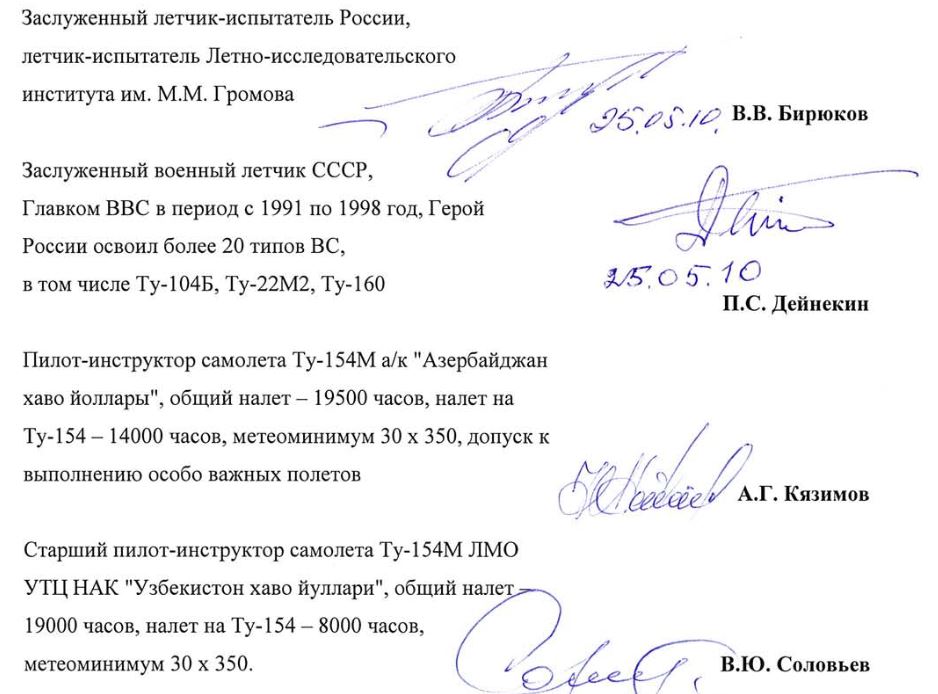
These experts — the top test pilots, Tu-154 pilots — were given an impossible task: to somehow twist the facts in order to show that the flight parameters provided by MAK for the final phase of the flight, including the go-around maneuver, were entirely correct, and that the sole blame lay with the crew… It should be noted that the attempt made by the aircraft commander to recover from the descent did result in a reduction of the vertical speed; however, due to insufficient altitude margin and the high rate of descent, this could not prevent the aircraft from colliding with a tree (a birch), which it struck with the left wing at an altitude of approximately 5 meters.
Note: The altitude loss required for the Tu-154 aircraft to transition from descent to climb — under the flight parameters present at the time of the crash (i.e., speed of 280 km/h, vertical descent rate of 7.5–8 m/s), with a vertical acceleration of 1.3 g and assuming correct and timely crew actions — is approximately 30 meters.
And the pilots — the best, most experienced ones — wrote it almost by inertia as it should result from the aerodynamic characteristics of the Tu-154M aircraft and the laws of physics.
Most likely, the internal Russian censorship within MAK let it slip unintentionally — failing to notice that the description provided by the expert pilots in their technical analysis did not align with the narrative of the official MAK report.
…The milk has been spilled. The truth slipped through — and now it can’t be undone.
Strange Involvement of Professor Paweł Artymowicz in Promoting the Russian Narrative on the 2010 Smolensk Crash….
ince April 2010, a blogger known as You-know-who has been actively engaged on the Gazeta.pl forum „Katastrofa w Smoleńsku,” and later on the Salon24 platform. From the very beginning, immediately after the release of the preliminary MAK report, he uncritically supported the Russian version of the Tu-154M crash and began systematically promoting this narrative. On Salon24, he has continued for years to present the Russian interpretation as the only valid one, while simultaneously discrediting any public figures or institutions—such as the Macierewicz Commission—that question the MAK findings. He has also harshly attacked independent bloggers, including the analytical and fact-based posts of blogger quwerty.
What raises even more serious questions is his remarkable media presence: despite being an astrophysicist with no formal qualifications in crash investigation, Artymowicz was regularly invited by mainstream Polish media—such as TVN and Gazeta Wyborcza—as an „expert.” He even participated in official meetings, having been invited by MP Marcin Kierwiński to serve as an „advisor” to a parliamentary team criticizing the work of the Macierewicz subcommittee. Most strikingly, he appeared on Echo of Moscow radio, where he once again defended the MAK version while harshly criticizing alternative views—even those coming from independent Russian experts.
How did an astrophysicist without formal credentials in aviation accident analysis become such a prominent voice in the Polish media and political scene on this issue? This is a question worth asking.
One telling example of Professor Artymowicz’s questionable competence in analyzing the Smolensk crash is his comment from May 24, 2011, posted on the Gazeta.pl forum. In that entry, he tried to explain the aircraft’s final seconds of flight, claiming that the process—from the initial roll after hitting the birch tree to ground impact—would take around 10 seconds. He based this on a convoluted reasoning involving changes in vertical speed and acceleration, saying:..
„When an aircraft starts rotating and losing lift (which happens significantly only after around 4 seconds), the rate of increase of vertical velocity slows down, but the vertical velocity itself doesn’t. You then have to wait until total acceleration becomes negative, then until vertical speed falls below zero, and only then until the negative speed brings the plane close to the flat terrain… Altogether, it takes ~10 seconds before the aircraft hits the ground. Check the flight data recorder if you want to be precise. I won’t bother—I’ve already reviewed it all and found not a single physical inconsistency in the MAK narrative.„…
However, when confronted with the fact that the official MAK report describes the aircraft’s roll and impact sequence as lasting only about 5 seconds, not 10, Artymowicz was forced to backtrack. In a follow-up post dated April 29, 2011, he admitted:..
„Alright, I checked the data—turns out it was closer to 5 seconds than 10. So it was more of a quarter-barrel roll than a half-barrel roll…”
This clumsy backpedaling and vague physical reasoning—confusing first and second derivatives, and misestimating time by 100%—raises serious concerns about Artymowicz’s understanding of basic flight dynamics. Despite such errors, he has continued to present himself in media and public forums as an authoritative voice on the Smolensk crash.
rofessor Artymowicz’s 2018 RMF24 Interview: Evasive, Superficial, and Questionable
In a 2018 appearance on RMF24, Professor Paweł Artymowicz once again presented himself as an authority on the Smolensk crash. He categorically ruled out the possibility of an explosion, and claimed there was “nothing unusual” in the aircraft disintegrating into thousands of tiny fragments—a statement that contradicts known cases of CFIT (Controlled Flight Into Terrain), especially under the relatively moderate impact conditions reported.
Observers noted several disturbing aspects of his demeanor during the interview:
He frequently avoided direct eye contact, looking down or to the side,
He displayed strange gestures and smirks when asked about sensitive topics,
Most notably, he failed to address any of the central findings raised by the Polish investigative team—such as the cockpit being torn apart in mid-air or evidence suggesting pre-impact separation.
His tone was patronizing, his responses vague and devoid of technical substance. At no point did he refer to factual data or engage with counter-arguments in a serious way.
This raises a fundamental question:
Does Professor Artymowicz hold any formal accreditation or investigator certification from a recognized Canadian aviation authority, such as Transport Canada or the Transportation Safety Board of Canada (TSB), which would entitle him to speak authoritatively on aviation disasters?
To date, no evidence has surfaced confirming that Artymowicz is licensed or formally trained in accident investigation. His background is in astrophysics—a respected field, but entirely unrelated to crash forensics, materials failure, flight dynamics, or black box data analysis.
Why then has he been repeatedly promoted by certain Polish media outlets as a credible voice on one of the most complex and politically sensitive air disasters in modern Polish history?
Example 1: Fabricating Climb Rate to Fit a Predefined Trajectory.
One of the most glaring examples of data manipulation by Professor Artymowicz involves his attempt to reconstruct the final trajectory of the Tu-154M during the so-called go-around maneuver.
In order to make his version of events match the official Russian narrative, he arbitrarily assumed that the aircraft was climbing at a vertical speed of 6 meters per second at the moment it struck the birch tree—this value has no basis in recorded flight data.
In fact, according to the expert report commissioned by the Polish Prosecutor’s Office, the actual rate of climb at that critical moment was approximately 1 m/s, not six. The difference is not trivial: the entire dynamic behavior of the aircraft—altitude, trajectory, forces—depends critically on that figure.
Yet Artymowicz himself openly admitted that the value was essentially made up to fit his desired outcome. This admission becomes even more absurd when contrasted with the lofty declaration placed in the footer of his own blog:
“What I say and write will defend itself.”
Statements like this may sound confident, but they do little to conceal the fact that his calculations are based on assumptions pulled from thin air, not grounded in data or physical principles.
Example 2: Artificially Inflating Contact Area to Dismiss the Absence of an Impact Point
In order to defend the Russian MAK report, which never identified a clear impact point at the Smolensk crash site (a highly unusual omission in any aviation disaster investigation), Professor Artymowicz attempted to explain away the absence of a crater or deep ground deformation.
To do this, he grossly exaggerated the contact area between the Tu-154M fuselage and the ground. In his blog, he claimed:
“In the Smolensk case, most of the vertical kinetic energy was absorbed by deformation and breaking of the fuselage. So I estimate that 10 to 20 cm of ground indentation would be the maximum possible. The contact area might be A > 100 m², but let’s conservatively assume A ≈ 80 m², to avoid assuming that the whole fuselage hits at once. The associated mass is roughly M = 60 tons. Thanks to the high horizontal velocity, we got total fragmentation—but let’s momentarily ignore that, and just calculate the vertical deceleration effect, as if the plane struck a slippery surface reacting only to downward force.”
This line of reasoning is scientifically misleading. By inflating the contact surface area, he artificially reduces the expected depth of deformation in the soil—thus justifying the absence of any visible impact crater on the Smolensk site.
But compare this to real-world data:
In the Kamchatka crash of an Antonov An-28, a much smaller aircraft (empty weight: only 3,900 kg) collided with a hillside during approach. The slope was 30 degrees, which would disperse vertical forces more than a flat surface. And yet:
he MAK report easily identified a clear impact groove, 22 cm deep and 3.5 meters long, caused by the contact of this lightweight plane with the ground.
Now contrast that with the Tu-154M:
More than 76 tons at impact (over 19× heavier than the An-28),
Striking nearly flat terrain,
Yet no measurable crater, groove, or shear marks on the main wreckage axis.
Artymowicz’s claim—that this is somehow „normal”—ignores real comparative cases and distorts fundamental principles of impact mechanics. His assumptions serve only to validate the MAK narrative, not to explain physical reality.
Example 3: Misrepresenting Sources and Ignoring Contradictory Data
Professor Artymowicz has repeatedly claimed that the go-around trajectory he calculated is consistent with the work of Professor Janusz Kowaleczko, whose technical report from 2013—“Reconstruction of the Final Phase of Flight of TU-154M”—is publicly available. However, this is a misleading assertion on multiple levels.
First, Professor Kowaleczko himself clearly stated that calculating the full trajectory was not the objective of his analysis. As he explains in the introduction to his report, the purpose was to study the feasibility of an aerodynamic half-roll (half-barrel) maneuver after the aircraft’s contact with the birch tree—not to independently reconstruct or validate the full flight path.
In fact, the trajectory used in Kowaleczko’s study was directly adopted from the Russian MAK report, not re-derived from raw data.
Even more critically, Artymowicz ignores specific data points in Professor Kowaleczko’s report that undermine the MAK version. For example:
On one graph, Kowaleczko shows the aircraft’s speed dropping to 243 km/h at a key point in the descent,
Yet in the MAK report, the stated speed at that same point is 266 km/h—a significant discrepancy of 23 km/h.
This is not a minor detail. Such a drop in speed can drastically alter the aircraft’s ability to generate lift and complete a controlled maneuver. But Artymowicz never addresses this conflict—instead, he casually concludes:
Our results were not contradictory.”
This kind of superficial endorsement of an external report—while ignoring its stated purpose and critical data inconsistencies—reveals a pattern of confirmation bias. Artymowicz selectively references only the parts that appear to support his claims, while omitting the actual content that contradicts them.
This is not objective analysis. It is rhetorical strategy dressed as science.
The impact point is the location where the aircraft’s fuselage first made contact with the ground. It is an easily identifiable trace, as it is typically the most prominent one.
– In Smolensk, no impact point was identified. – Not by the MAK. – Not by the Lasek Commission. – Not by Macierewicz’s Subcommission.
At the Smolensk crash site, the largest ground marks identified — for example in the Lasek report — were grooves in the soil at the beginning of the debris field, described as traces left by the vertical stabilizer.
If there is no impact point at the Smolensk crash site, it would imply that the Tu-154M did not hit the ground in one piece— whatever that may mean.
According to guidelines from international aviation organizations, identifying the impact point is a mandatory duty of those investigating the crash.
(This is important, among other things, for interpreting the location of aircraft debris in relation to the point of first impact, which can be crucial for determining the sequence of events during the crash.)
another example of such regulations from Mongolia
Why was this never was done?
The impact point was not identified — nor was the absence of an impact point at the crash site ever acknowledged.
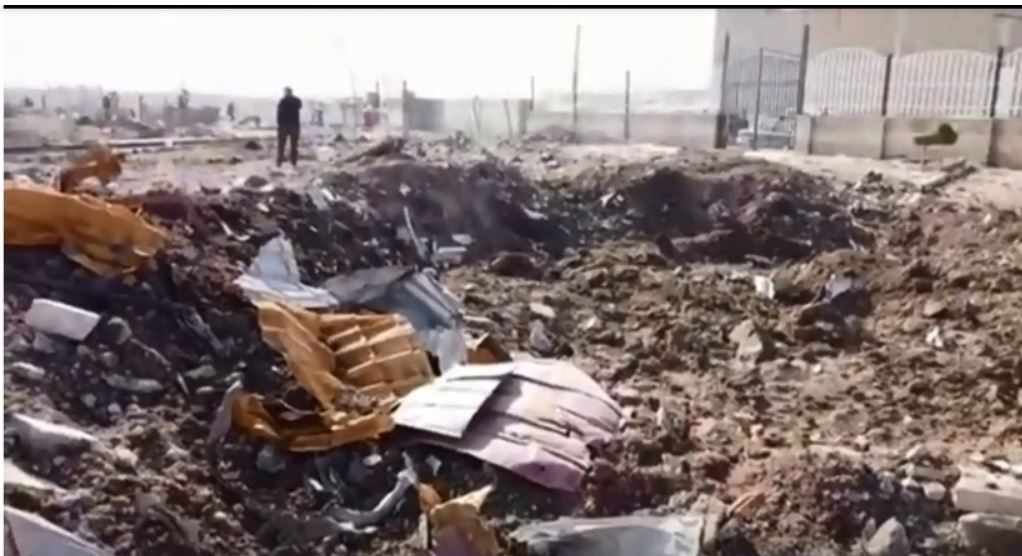
The impact with the ground created a large hole in the park.








 Tytuł witryny