Smolensk crash- MAK falsehood

  • Technical Comments on NIAR’s Analysis of the Tu-154M Door “Embedding” in the Ground

    Critical remarks on the sufficiency of the energy-based argument

    Dear Sir or Madam,

    After reviewing NIAR’s study prepared for the Polish Subcommittee on the Tu-154M crash, I would like to submit the following technical remarks concerning the hypothesis that one of the passenger doors was driven (“embedded”) into the ground prior to the main fuselage impact.

    1. Energy is necessary, but not sufficient

    In your report, the conclusion that the door could have penetrated the soil is based essentially on an energy argument: that the kinetic energy available in the motion of the fuselage and its fragments would have been sufficient to drive the door into the ground to the observed depth.

    While this may be true at the level of an energy budget, such a criterion is not sufficient. For penetration to occur, the following must also be satisfied:

    • proper orientation of the door with respect to the velocity vector (approximately normal to the door plane),
    • existence of a stiff load path capable of transmitting the impact force,
    • realistic contact mechanics (penetration vs. sliding, tumbling, or bouncing),
    • dynamic behaviour of the disintegrating fuselage structure.

    These factors were not analysed in a way that would justify the conclusions drawn.

    2. No “hammer”: a disintegrating fuselage cannot drive the door as a solid striker

    The door-embedding scenario implicitly assumes that the disintegrating fuselage acts like a hammer transferring a concentrated impulse into the door.

    From a structural-mechanics standpoint this is not realistic, because:

    Thus, even if the total energy of motion was theoretically sufficient, there existed no structurally sound mechanism to deliver this energy to the door in the form of a focused penetration impulse.

    In the area of the door, the fuselage lost its structural integrity and stiffness due to severe fragmentation.
    A disintegrating shell structure cannot provide a stiff, continuous load path needed to transfer a concentrated impact force.

    When the “hammer” (the surrounding structure) breaks apart, most of the energy is dissipated in its own crushing and tearing, not transmitted directionally into the door.
    Mechanically, this is equivalent to trying to drive a nail with a hammer that disintegrates before it hits the nail.

    3. Incorrect or missing geometry and kinematics of the door motion

    For the door to be embedded in the ground:

    • the direction of its motion must be approximately perpendicular to its plane,
    • the angle of impact must favour penetration and not tangential sliding or tumbling,
    • the door must maintain a reasonably stable orientation shortly before contact with the soil.

    However:

    • reconstructed motion of the fuselage fragments indicates a highly oblique velocity vector,
    • the orientation of the door within the breaking fuselage is unfavourable for penetration,
    • no credible mechanism is presented that would align the door’s normal vector with the velocity vector and stabilise it prior to impact.

    In practice, with such geometry the door would be expected to strike in a glancing, edge-on, or tumbling manner, leading to deformation and rotation—not deep, axial penetration.

    4. Revised wording: the energetic argument

    To incorporate the requested clarification:

    Even if the door obtained energy sufficient to drive the door into the soil, without the proper geometry of impact there is no possibility of penetration—only bouncing, sliding, or rotational motion.

    This expresses the key mechanical limitation: energy alone cannot compensate for the wrong orientation and lack of a stiff striker.

    5. Observed door deformation contradicts a penetration scenario

    Photographs of the door show:

    • no axial crushing pattern typical of elements driven into soil under normal impact,
    • deformation consistent with lateral crushing,
    • absence of signatures of high-angle penetration into cohesive ground.

    This contradicts the scenario of the door being driven deeply into the ground like a projectile.

    6. Conclusion

    The hypothesis that the Tu-154M door was embedded in the soil in the manner described by NIAR is mechanically implausible, because:

    • it relies solely on a global energy argument,
    • it neglects essential geometric and dynamic conditions,
    • it assumes a stiff striker that did not exist (the fuselage was already breaking apart),
    • it is inconsistent with the observed pattern of deformation on the actual door.

    A technically sound conclusion would require a revised analysis including:

    • full 3D kinematics of the door and adjacent structure,
    • realistic modelling of structural fragmentation and loss of load paths,
    • detailed contact mechanics between the door and soil,
    • direct comparison with the observed damage to the recovered door.

    Respectfully,

    The Author

  • A Bitter Awakening After 16 Years:Assistant M.Jaworski Discovers the “16 Meters”

    On November 17, 2025, we witnessed a small yet symbolic turning point in the propaganda-driven narrative of the Smolensk crash.
    Michał Jaworski, long-time media assistant to Prof. Paweł Artymowicz (a Canadian astrophysicist promoting the MAK/KBWLLP version), has finally — after 16 years — noticed a critical piece of data that was there from the very beginning in the Polish KBWLLP (Lasek) Report.

    The key quote:

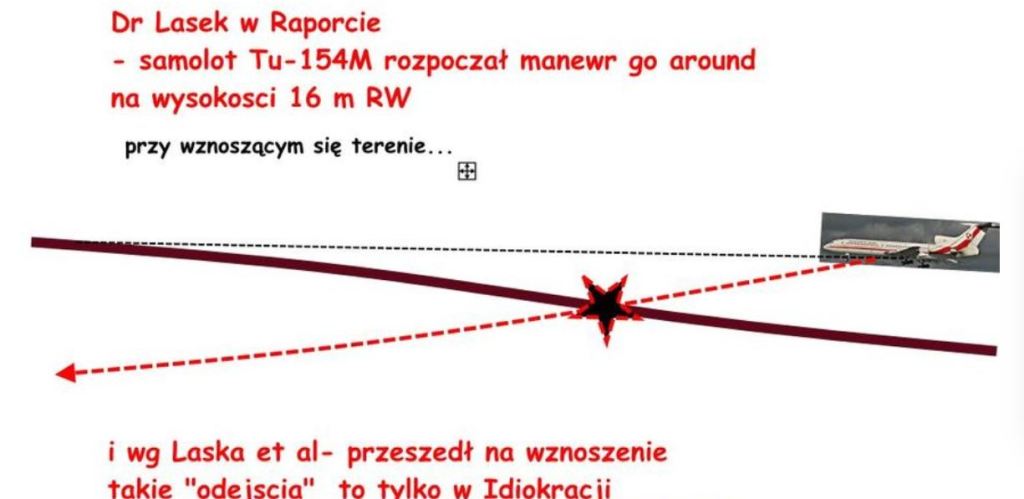
    One second later, at 06:40:58.5, there was an increase in thrust and a sharp pull on the control column. This occurred 1187 meters from the runway threshold, at an altitude of 16 meters radio height.”
    — Polish KBWLLP Report, p. [exact page]

    This statement clearly places the initiation of the go-around maneuver at just 16 meters above ground. However, given the known descent rate, aerodynamic configuration (full flaps, idle thrust), and terrain slope at Smolensk, such a go-around was physically impossible. The aircraft would have needed to perform a „miracle climb” from beneath the ground

    Here’s the ironic twist…

    For 15 years, Mr. Jaworski commented, dismissed, corrected others, and defended the official line — without noticing this elementary number: 16 meters RW.

    Only after this quote was repeatedly posted in an online discussion by the author of this note, did Jaworski:

    …and immediately began deflecting, claiming the crew was „trying to save themselves” and „fiddling with the thrust lever,” which somehow justifies everything.

    Initially accuse his opponent of fabrication,

    Then, eventually admitted:
    “It seems I got it wrong. That was my mistake. Mea culpa.”

    fficial Disinformation at the Highest Level

    Let us recall: Prof. Artymowicz and Mr. Jaworski were invited to the Polish Parliament (Sejm) by MP Marcin Kierwiński, a close ally of Donald Tusk.
    Their „expertise” was used in high-level briefings, interviews, and public reports — shaping the media and institutional narrative for years.

    Now, we learn that they overlooked a basic flight parameter — the reported altitude of go-around initiation — which contradicts the laws of physics. This is not a minor oversight. It’s a fundamental analytical failure.

    What should be done now:

    🔻 Artymowicz, Jaworski, Kierwiński:

    Support calls to reopen the investigation, since the KBWLLP report contains physically implausible claims.

    Publicly acknowledge the mistake, and the misleading effect it has had.

    Withdraw from their role as “experts” in this matter, after missing such a core detail for 15 years.

    Investigative journalists should now ask:

    • Did Maciej Lasek and his team realize they wrote that the go-around started at 16 meters RW?
    • Do they have any simulation showing a successful go-around from that height with those parameters?
    • Shouldn’t there be a new technical review, given this internal contradiction?

    Epilogue: Sixteen Meters That Change Everything

    In physics, numbers matter. Not emotions. Not politics.

    If the Tu-154M could not physically go around from 16 meters, then the official storyline of “attempted go-around” collapses.
    And if those who crafted the official version never even noticed this figure in their own report — maybe it’s time to ask:

    Who is really spreading disinformation — the critics, or the self-proclaimed experts who never read their own sources carefully?

  • 🪵 The Second Birch, the Spruce, and the Catastrophe of Physics in Smolensk

    In the materials published by the Lasek Team, a second birch and a broken spruce appear. The problem is, there was only one airplane.
    The lack of location data, contradictory photographs, and opposite directions of tree breaks clearly show that this “second birch” has nothing to do with the well-known Bodin birch.
    Once again, we see how, in the Smolensk case, analysis was replaced by staging — and how the catastrophe of physics became part of the official narrative.


    I. Two Different Trees – Two Different Places

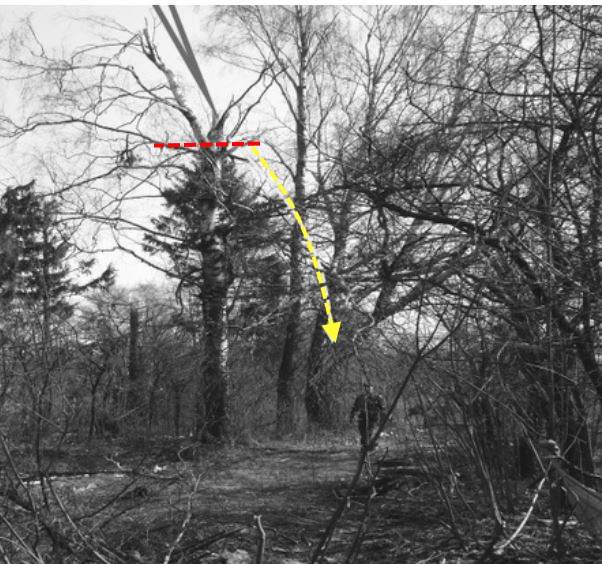
    In the documentation released by Maciej Lasek’s team (KBWLLP), there is a photograph of a broken birch tree. Its exact location is not given. No coordinates. No map. Not even a clarification whether this is the same birch described by the MAK report — the famous Bodin birch.

    A close comparison of photos proves that these are two different trees:

    FeatureBodin Birch“Second Birch” (Lasek Team)
    Break heightAbout 5–6 m above groundSimilar height
    Direction of breakBroken crown pointing upward, tree tip downward, resting on the groundBroken crown pointing downward, tree tip upward, hanging among nearby branches
    Position after breakTrunk driven into the ground, stable positionTrunk suspended, no ground contact
    SurroundingsOpen area near Bodin’s fence, few trees nearbyDense grove — spruces and pines in the background

    These are objective differences. The tree shown in Lasek’s photo is not the Bodin birch — it’s another tree, in another place, never identified or mapped.


    II. The Spruce and the “Second Birch” – Trees from Another Story

    In the same materials, a broken spruce is visible — tall, thick, and snapped about seven meters above the ground. Thus we have three trees: the Bodin birch, the “second birch,” and the spruce.

    They could not have been broken by the same aircraft.
    Once the first collision occurred, the plane would have lost stability; after that, there could be no “precise hits” on further trees in the same line.

    Even if those trees stood roughly along the same axis, simple logic remains: a catastrophe doesn’t happen three times in a row.
    You can’t crash the same airplane three separate times.


    III. No Location – No Verification

    Lasek’s team had all the necessary data: aerial photographs, the MAK trajectory, digital terrain models, and high-resolution imagery. Yet they never published the coordinates of either the second birch or the spruce.
    They simply failed to perform the basic verification — assigning GPS positions to the trees visible in the photos.

    That’s not a lack of ability — it’s a lack of will. Because once the coordinates were known, it would become obvious that those trees stand off the actual flight path — somewhere else entirely.


    IV. Reactions of Commenters – Emotion Instead of Argument

    When I pointed out these inconsistencies, the response was predictable. One commenter wrote (April 29, 2023):

    “You saw but understood nothing. Can you give the coordinates of the photo point and the direction of view? Do you even know what perspective is? Too difficult a word for such an ignoramus like you. Without such details, your ‘scholarly’ analysis is worth nothing — fit only for the toilet. Let’s remind ourselves, comrade conspiracist, where people keep your pseudo-scientific nonsense…”

    That post received seven upvotes and one downvote. My factual, calm comment — zero upvotes and thirty downvotes.

    That says it all about today’s “debate culture.” Insults get applause; observation gets punishment. But you don’t need GPS data to see that two trees with opposite directions of break are not the same tree.


    V. Physics vs. Propaganda – the Catastrophe of Physics in Smolensk

    From the very beginning, the greatest victim of this story has been physics itself. Not the aircraft, not the trees, but the basic law of cause and effect — replaced by rhetoric and belief.

    In official narratives, gravity gives way to political convenience; aerodynamics to storytelling. The airplane continues to “fly” and “break trees” long after it should have fallen — because the scenario demands it.

    That is why I have long called Smolensk not only an air disaster, but also a catastrophe of physics.
    When facts contradict a theory, you don’t bend the facts — you correct the theory.
    No one in the official reports dared to do that.


    Author: Erevnitis Istorias
    Independent researcher analyzing technical and photographic documentation of the Smolensk crash.
    Founder of the blog “The Catastrophe of Physics in Smolensk” — a space where facts take precedence over belief.

  • The Phone That Survived 100 g? Physics vs. the MAK Report

    My father’s mobile phone was not damaged and worked. Among his belongings were nearly intact LOT flight tickets and a schedule of the visit to Katyn. Yet the Russians made me sign a document allowing them to burn his things, claiming they were ‘shredded, bloodied, soaked with gasoline and mud, nothing left of them.’”
    Małgorzata Wassermann, daughter of Zbigniew Wassermann, one of the victims of the Smolensk crash.

    🖼️ Illustration:
    A glowing smartphone standing amid ashes and smoke — a symbol of surviving evidence defying the official narrative.

    🔥 What Survived – and What Shouldn’t Have

    The statement of MP Małgorzata Wassermann is not only a moving personal testimony but also a logical challenge to the official narrative of the Russian MAK report and its Polish echo — the report of Maciej Lasek’s Commission.

    The Russians claimed that during the crash, forces exceeded 100 g, allegedly causing instant death of all passengers and the “complete destruction of clothing, leaving only rags.”
    Yet the belongings later returned to the family — a working mobile phone, almost intact paper flight tickets, and a printed Katyn visit schedule — tell a completely different story.

    📱 Physics Has No Exceptions

    A load of 100 g means forces capable of tearing apart steel structures, crushing seats, and destroying any small object.
    Under such conditions:

    • a phone would break into pieces,
    • its battery would disconnect or explode,
    • the screen would shatter,
    • and paper would be torn or burned instantly.

    If a phone survived undamaged and functional, and if paper documents remained legible, then the actual forces must have been far lower, and the official version of “total destruction” appears physically impossible.

    🧩 Questions Nobody Dared to Ask

    Why has the Lasek Commission never addressed these inconsistencies, even though they undermine a key element of the MAK narrative?

    How could delicate paper tickets survive if the victim’s clothing was supposedly destroyed?

    Why did Russian officials pressure the family to authorize burning the belongings, which were clearly not destroyed?

    Who approved such actions instead of insisting that all personal effects be secured as evidence?

    ⚖️ What the Lasek Commission Should Have Done

    The commission led by Dr. Maciej Lasek — established by the Polish government to “explain and popularize” the MAK findings — should have responded to these facts in line with physics and investigative procedure by:

    • Reconstructing the physical scenario to determine if a mobile phone could survive 100 g forces.
    • Verifying the authenticity of recorded acceleration data, considering the possibility of simulation or manipulation.
    • Demanding full documentation of personal belongings of all victims, including photos, condition reports, and handover records.
    • Publicly addressing the Wassermann testimony as material evidence contradicting official claims.

    Failure to do so shows a lack of scientific integrity and confirms that the Lasek report was more a defense of a political narrative than a search for truth.

    Conclusion

    Physics does not bend to politics — and the truth about Smolensk still waits for someone willing to face it.

    If the phone survived, it could not have been 100 g.
    If the papers remained intact, there was no “fire that burned everything.”

  • Why increasing angle of attack during go-around with insufficient thrust in the Tu-154M could lead to aerodynamic stall — and what the 2010 Moscow simulator experiment really shows

    The scenario

    In the final seconds of the Tu-154M flight over Smolensk North airfield on April 10, 2010, the aircraft was in the following configuration:

    • Mass: approx. 76,000 kg
    • Flaps: 36° (landing configuration)
    • Landing gear: deployed
    • Forward velocity: ~270 km/h (~75 m/s)
    • Vertical descent speed: ~7 m/s
    • Thrust: engines at idle (~40 kN total), beginning to spool up
    • Time required to reach full take-off thrust: ~8.5 seconds (per D-30KU-154 engine specs)

    In such a situation, pilots may instinctively try to pull back and raise the nose, increasing the angle of attack (AoA) to stop the descent.

    This intuitive reaction is aerodynamically dangerous under these conditions, and can quickly lead to stall and loss of control.

    Why increasing angle of attack without sufficient thrust is dangerous

    Drag increases dramatically:

    As AoA increases, induced drag rises non-linearly with the square of lift coefficient (CLC_LCL​),

    The aircraft demands even more thrust, which it does not have at that point.

    Approaching the critical AoA — stall risk:

    Beyond ~16–18°, airflow separates from the wing’s upper surface,

    Lift collapses, and the aircraft may enter a deep aerodynamic stall.

    Loss of pitch control:

    In deep stall, elevator effectiveness is reduced,

    Tu-154M has a T-tail configuration, increasing the risk of „deep stall”, where the horizontal stabilizer is immersed in turbulent wake behind stalled wings.

    Post-stall trajectory is ballistic:

    The aircraft becomes nearly uncontrollable in pitch,continues on a steep descending arc with no meaningful aerodynamic recovery unless large altitude and thrust margins are available — which they weren’t.

    Continues on a steep descending arc with no meaningful aerodynamic recovery unless large altitude and thrust margins are available — which they weren’t.

    The 2010 Moscow simulator experiment: unrealistic success?

    In July 2010, the Interstate Aviation Committee (MAK) conducted a go-around simulation on a full-flight Tu-154M simulator in Moscow. Their reported results showed:

    Aircraft successfully transitioned into a climb.

    Sink rate arrested within 19–23 meters,

    Maximum load factor: up to 1.5 g,

    But serious doubts exist about the realism of this simulation:

    1. Thrust ramp-up may have been artificially accelerated:

    • Real D-30KU-154 engines require ~8.5 seconds from idle to take-off thrust,
    • The simulator may have implemented idealized (faster) thrust response for testing purposes.

    2. Load factors in the simulation exceeded those recorded in the actual flight:

    • Flight data recorder (FDR) from Smolensk flight: max 1.35 g,
    • Simulator run: 1.5 g, suggesting aggressive pitch-up or unrealistic flight envelope margins.

    3. In the simulation, flaps were retracted or repositioned (e.g., 36° → 28°):

    Without this change, drag remains too high for successful climb-out.

    In the real flight, no such configuration change occurred — no command, no attempt.

    Conclusion for investigators and analysts

    • Increasing the angle of attack under low thrust and high drag conditions does not stop descent — it accelerates stall,
    • In Tu-154M, this leads to rapid loss of lift and control, especially with gear/flaps extended,
    • The 2010 Moscow simulation, although technically interesting, used flight parameters not observed in the real Smolensk flight.

    Therefore, its conclusions — particularly the minimal sink rate of 19–23 meters — cannot be considered physically representative of what was possible in the actual aircraft’s state.

    Summary:

    • The combination of low initial thrust, landing configuration, and attempting to pitch up aggressively would have pushed the Tu-154M into a deep stall, not into a climb.
    • Realistic simulation shows minimum altitude loss of ~100 meters, unless flaps were retracted and full thrust already available.
    • Any attempt to claim otherwise must justify how thrust, drag, load factors and configuration handling in the simulator reflect actual aircraft limitations — which is highly questionable.

  • Errors Made by Swedish Expert Christer Magnusson in His Report for the Polish Subcommittee

    When analyzing the documentation prepared for the Polish Subcommittee on the Smolensk crash, one cannot ignore the technical mistakes made by the Swedish expert Christer Magnusson. His report, instead of clarifying key issues, introduced several inaccuracies that weaken the credibility of the findings.

    The most serious problems include:

    Lack of Comparative Case Studies – Other well-documented crashes with similar parameters (descent speed, angle of impact, load factors) were ignored, even though such comparisons are the foundation of professional accident investigation.

    Misinterpretation of Flight Dynamics – Magnusson relied on oversimplified models of aircraft behavior, ignoring the real aerodynamic characteristics of the Tu-154M, particularly in landing configuration with flaps extended and engines at reduced thrust.

    Incorrect Data Correlation – Certain numerical values, such as descent rates, thrust settings, and altitude changes, were combined in ways that contradict the official FDR data and known performance parameters of the aircraft.

    Speculative Conclusions – Instead of basing his analysis on verified measurements, Magnusson drew conclusions from assumptions that were not supported by either Russian or Polish documentation.

    The consequence is that Magnusson’s expertise did not strengthen the Subcommittee’s work but rather opened space for criticism, both in Poland and abroad. The credibility of any investigation depends on precision and verifiable physics, not on speculative interpretations.

    This raises a serious question: why was such an analysis, marked by methodological weaknesses, accepted as part of the official investigation?

    A Key Error in Christer Magnusson’s Analysis Supporting the Russian MAK Narrative.

    In his report concerning the Smolensk crash, Swedish expert Christer Magnusson made a critical error when reconstructing the final trajectory of the Tu-154M. This mistake, whether intentional or not, directly supports the Russian MAK version of events.

    Magnusson concluded that “during the last 3 seconds before the birch tree, the aircraft’s altitude above the slightly rising terrain remained constant at about 6.2 meters.” Later, the Polish Ministry of Defense Commission — which criticized the Subcommittee’s report and openly supported the MAK findings — echoed this claim, stating that “the expert carried out a detailed analysis of the aircraft’s trajectory.”

    But here lies the problem:

    If the Tu-154M had indeed flown on a flat trajectory at a constant height of about 6 meters right up to the birch tree, then after losing the wingtip it could not possibly have climbed by more than ten meters in the next seconds, while simultaneously rolling rapidly to the left – as the MAK report asserts.

    Such a scenario is aerodynamically inconsistent with the aircraft’s configuration (flaps extended, landing gear down, engines at reduced thrust). The physical limitations of lift and control forces make it impossible.

    By failing to recognize this contradiction, Magnusson’s “flat trajectory” analysis effectively provides indirect support to the Russian MAK narrative – a narrative that has long been criticized for its internal inconsistencies and lack of adherence to basic flight physics.

    Instead of clarifying the key issue of the Tu-154M’s last seconds of flight, Magnusson’s conclusion deepens confusion and undermines the credibility of those Polish experts and institutions that chose to rely on his flawed opinion.

  • Tu‑154M go‑around: what the Russian manuals require vs. what the MAK reconstruction assumes

    Tu‑154M go‑around: what the Russian manuals require vs. what the MAK reconstruction assumes

    1) What the Russian Tu‑154 manuals actually say (practical aerodynamics)

    Engine regime strongly affects longitudinal balance. Reducing power increases a nose‑down pitching moment and bends the flight path downward; one must promptly correct with control column and MET (trim) towards nose‑up. At low altitude, avoid reducing RPM more than 3–5 %.

    Landing/approach example (Tu‑154B, indicative for Tu‑154M): V≈270 km/h, α≈6°, CY≈1.263, CX≈0.252. If you sharply increase α to ≈11.6°, CY≈1.75 and CX≈0.315; drag rises from ≈12,272 kgf to ≈15,340 kgf.

    With gear down, flaps 28°, slats 18.5° and V≈288 km/h, level‑flight drag ≈ 11,400 kgf. With flaps 45° and V≈270 km/h it’s ≈16,000 kgf; i.e. going 28° → 45° needs +≈4,600 kgf extra thrust for the same level condition.

    Rule of thumb: for clean wing at 400 km/h the required thrust is only ≈5,300 kgf, but at 270 km/h with full high‑lift the required thrust roughly triples. In IMC/low‑altitude work you must account for this.

    What this means: In the landing configuration the Tu‑154’s drag climbs steeply with any extra lift demand (CD≈CD0+k·CL²). If thrust is low, you also start with a nose‑down bias to overcome. A go‑around from near‑idle therefore needs thrust first, then pitch—exactly what the manuals teach.

    2) The MAK initial conditions at Smolensk (as reconstructed)

    Thrust: engines near idle at go‑around initiation („малый газ”).

    Speed: ≈76 m/s (≈274 km/h IAS).

    Vertical speed: ≈−7 m/s (descent).

    Configuration: landing—slats extended, flaps ~36°, gear down.

    Those are precisely the conditions where the manual cautions are most binding: low thrust + high drag + full mechanisation + manual control under stress.

    3) A quick physics check (2‑second window)

    Even if the pilot commands a prompt normal‑load increase to Ny≈1.3–1.35 g, the vertical acceleration is only (Ny−1)g ≈ +3.2…3.4 m/s². From −7 m/s you therefore need about 2 s just to stop descending—and that assumes instantaneous response and no extra drag. In reality:

    raising α to generate lift immediately raises CD (induced and profile), so V decays;

    thrust–pitch coupling at low power adds a nose‑down bias you must cancel with more α (even more drag)

    engines from near‑idle spool slowly; the first ~2 s bring minimal thrust.

    4) Human factors and realistic variability

    A simulator series (“English case” style) with manual control, idle→go‑around thrust, and crew stress vs training shows:

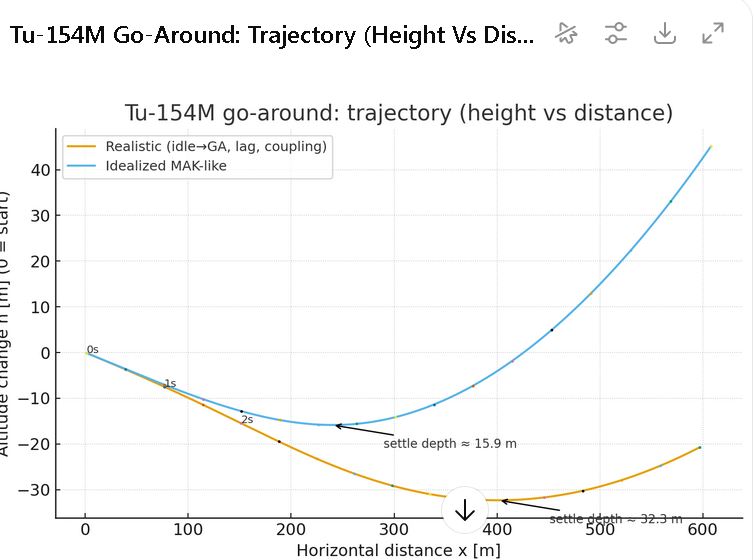
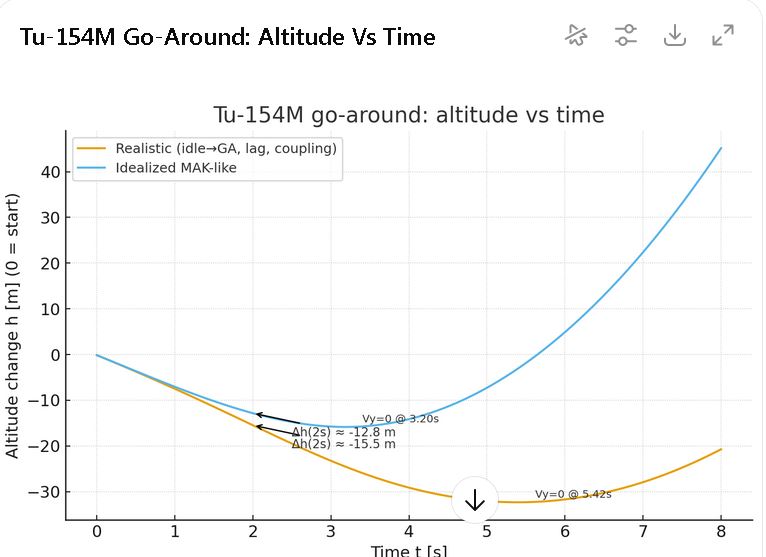
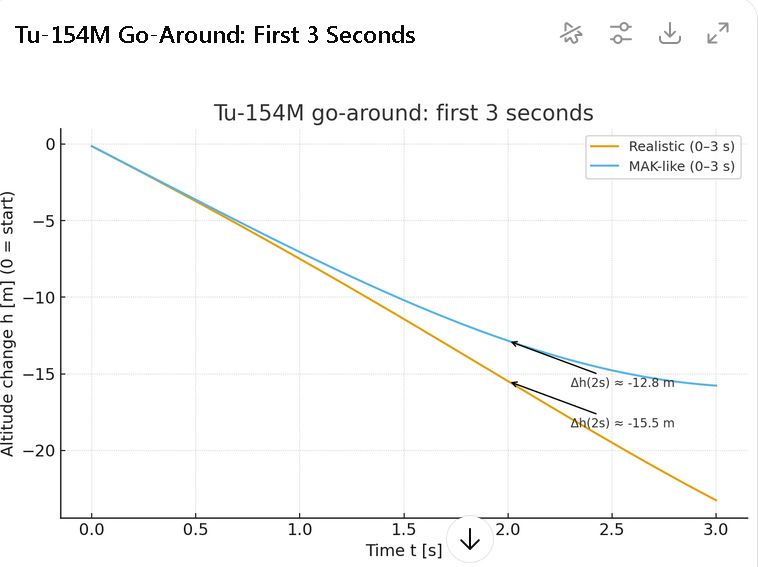
    Δh after 2 s: typically −15.5 m (stressed/untrained) vs −14.8 m (trained), when thrust–pitch coupling is modelled.

    Depth to arrest descent (Δh to Vy=0): around −45…−50 m (stressed/untrained) and ≈−30 m (trained).

    Speed loss to Vy=0: about −5…−7 m/s.

    These ranges match the manuals’ qualitative warnings: from near‑idle, a Tu‑154M will sink first before climbing, and poor timing/overshoot can make the sink notably deeper.

    Contrast with an “idealised” trace: If you assume very fast Ny response, immediate thrust command and no coupling, you can obtain a shallow Δh to Vy=0 ≈ −16 m and ΔV ≈ −2.7 m/s. That picture, however, omits the Tu‑154’s known characteristics and crew delays—it is not a faithful reconstruction of a real‑world go‑around from near‑idle.

    5) Why this matters for the 2010 Moscow simulator run

    A faithful reconstruction of the Smolensk go‑around must include, at minimum:

    1.Engine model: idle at initiation; realistic spool‑up to GA (several seconds); thrust–pitch coupling (nose‑down bias at low TTT).

    2.Aerodynamics: landing‑config drag law calibrated to Tu‑154 data (e.g., near 270 km/h, α: 6° → 11.6° raises drag from ≈12.3 t to ≈15.3 t); correct S, ρ, mass.

    3.Ny envelope: ≤~1.35 g as an operational cap for approach/landing; no forced, sustained overshoots.

    4.Dynamics & delays: in‑axis lag (I‑order + pure delay) for Ny response; manual control profiles (recognition time, throttle‑push delay, overshoot/jitter under stress).

    5.Outputs to disclose: time‑aligned traces of column/elevator, Ny, α, thrust, V/Vy, plus exact aero database used (CD0, k, configuration scalars).

    Without these, a simulator “result” risks being an idealised training picture, not a physics‑consistent reconstruction of the MAK scenario.

    6)Numbers and assumptions used here (for transparency)

    Initial state: m≈76 t; V≈76 m/s (≈274 km/h); Vy≈−7 m/s; landing configuration (slats extended, flaps ~36°, gear down); ρ≈1.2 kg/m³; S≈201 m².

    Drag model: CD=CD0+kCL2C_D=C_{D0}+kC_L^2CD​=CD0​+kCL2​ calibrated at 270 km/h using Tu‑154 book points: CD0≈0.129C_{D0}≈0.129CD0​≈0.129, k≈0.030k≈0.030k≈0.030 (yields ≈12.3 t → ≈15.3 t drag when α jumps 6°→11.6°).

    Thrust: total GA thrust scaled to order‑of‑magnitude values; idle for ~2 s; linear spool‑up over ≈4 s; thrust–pitch coupling modelled as a nose‑down bias at low TTT.

    Human factors: Monte‑Carlo over recognition delay, throttle‑push delay, Ny ramp slope, overshoot/jitter, and Ny dynamics (τ, Td), with “untrained/stressed” vs “trained” parameter bands.

    Caveat: The figures above are illustrative (engineering‑level consistency check), not a claim to replace FDR‑grade reconstruction. They are, however, anchored to Tu‑154 practical‑aerodynamics data and reproduce the qualitative behaviours that the manuals emphasise.

    7) Takeaways (for investigators and readers)

    A Tu‑154M go‑around from near‑idle in full landing configuration will first lose height—order 12–16 m in ~2 s, then tens of metres more before Vy reaches zero—unless thrust arrives first and control is precise.

    Any simulator trace that shows a shallow sink (≈15–20 m to Vy=0) with minimal speed loss from near‑idle is incompatible with the Tu‑154’s documented behaviour and with manual, stressed crew response.

    To be credible, a reconstruction must publish the inputs and aero model, not just the plotted results.

  • The MAK Forgers’ Blunder in the Preliminary Report; Attempt to Cover Up the Falsification of the Trajectory with a Simulator Experiment in Moscow

    In a hurry..— What to do?
    What to do?
    How to show that this was not a Special Operation,
    but a CFIT — the fault of the Polish pilots…

    The Russians were eager to publish and imprint their (fabricated) version of events in the public consciousness as quickly as possible.
    Despite their well-known mastery in manipulating, deceiving, and concealing the truth,
    they still made a critical mistake.

    They brought the fabricated trajectory of the final segment of the flight
    too far down into the ravine…
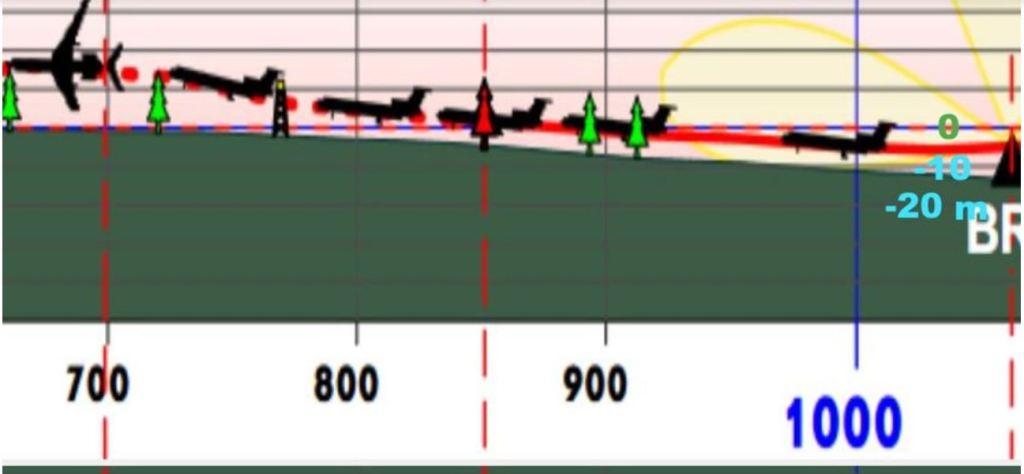
    This is clearly visible on the diagram.

    But this becomes clearly visible only when you put on the diagram from the Preliminary Report the points whose coordinates are given in the Report.
    I did this…


    — And this is how it would look in reality:
    the aircraft would have hit the ground while descending…

    The MAK/Russians wanted to cover up this blunder,
    so quickly — in July 2010 — they arranged a staged demonstration, a manipulation,
    on a simulator in Moscow, into which they easily drew the naïve Dr. Edmund Klich, who took part in this experiment as if it were for Sheremetyevo airport… and noticed nothing suspicious.

    The Russians supposedly performed on the simulator a go-around maneuver “like in Smolensk,”
    with “parameters like in Smolensk,”
    but in reality they hid some of the parameters (for example, engine power setting)
    and ignored the fact that in Smolensk the terrain was rising — and quite noticeably.
    In the simulator experiment the terrain was… flat.

    And so, in the Tu-154M simulator experiment, it was not possible to transition to a climb
    when starting the maneuver at 20 meters above the ground…

    .But they described it in such a way that supposedly
    the result of the experiment matched the MAK Preliminary Report.

    And so,
    clearly and with evidence, I have proven
    that the Russian MAK narrative about an alleged CFIT,
    about the supposed fault of the pilots,
    is a LIE.

    Nothing can be done about it now.
    It cannot be hidden.
    The Russian version about an alleged CFIT
    is a LIE.

    The milk has been spilled.

  • Chris Protheroe-Air Crash Expert who made huge mistakes in Smolensk Tu-154M Crash Analysys

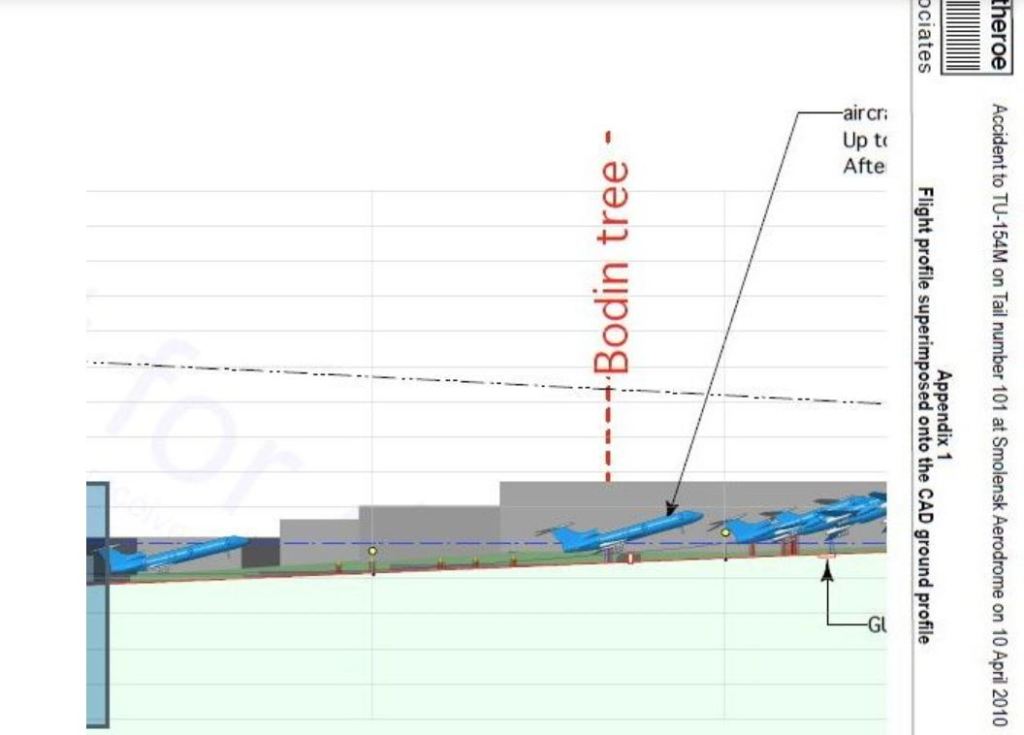
    In the study prepared for the Macierewicz Subcommittee concerning the Tu-154M crash in Smolensk, Chris Protheroe — an internationally renowned aviation expert — committed serious errors in describing the trajectory of the Tu-154M during the final phase of flight, specifically in the section just before and after the collision with the birch tree.

    Just look at the pictures from this study…

    The Tu-154M reaches the birch tree on a level flight path, and then — after losing a large section of the wing and rapidly rolling onto its side — it suddenly begins a steep climb… Such things are possible… but only in Disney cartoons

    There are types of aircraft that could still increase their climb rate despite losing a significant portion of the wing and rolling at a rate of 40 degrees per second — provided that their hydraulic systems, avionics controls, or other critical components were not damaged at the moment of collision with the birch tree.

    For example: the Russian aerobatic aircraft Su-31

    A fighter aircraft such as the Su-27, using afterburners, could in principle still increase its climb rate even after losing part of a wing and entering a rapid roll

    But an aircraft like the Tu-154M, in landing configuration with extended high-lift devices and landing gear, and with the engines operating at just below nominal thrust — as stated in the MAK Report — would not have been capable of doing so

  • The Russian MAK experts inadvertently admitted in their report that the go-around trajectory had been falsified.

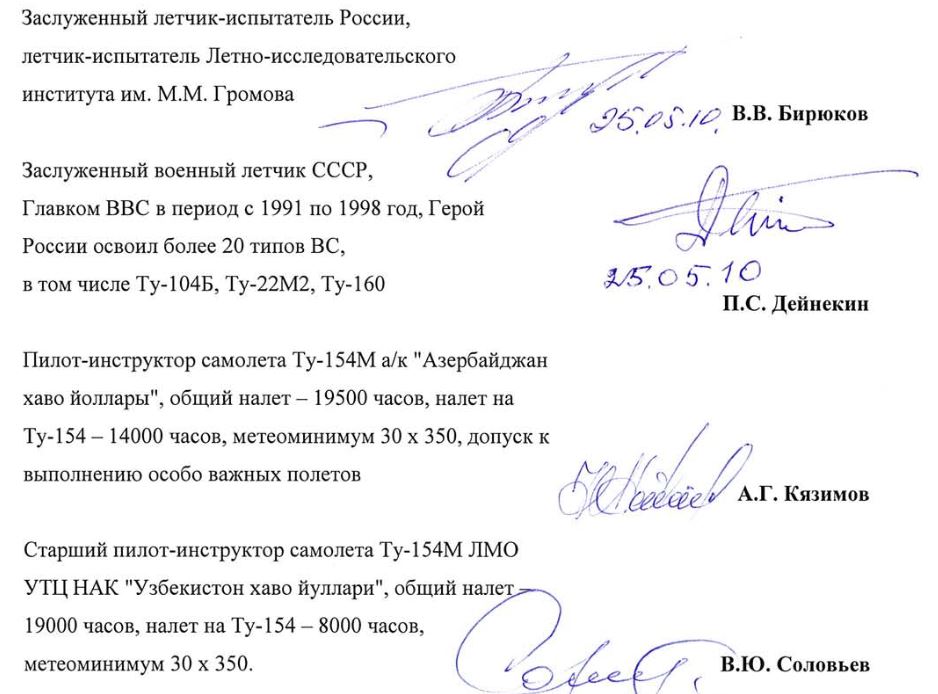
    These experts — the top test pilots, Tu-154 pilots — were given an impossible task: to somehow twist the facts in order to show that the flight parameters provided by MAK for the final phase of the flight, including the go-around maneuver, were entirely correct, and that the sole blame lay with the crew…
    It should be noted that the attempt made by the aircraft commander to recover from the descent did result in a reduction of the vertical speed; however, due to insufficient altitude margin and the high rate of descent, this could not prevent the aircraft from colliding with a tree (a birch), which it struck with the left wing at an altitude of approximately 5 meters.

    Note:
    The altitude loss required for the Tu-154 aircraft to transition from descent to climb — under the flight parameters present at the time of the crash (i.e., speed of 280 km/h, vertical descent rate of 7.5–8 m/s), with a vertical acceleration of 1.3 g and assuming correct and timely crew actions — is approximately 30 meters.

    And the pilots — the best, most experienced ones — wrote it almost by inertia
    as it should result from the aerodynamic characteristics of the Tu-154M aircraft and the laws of physics.

    Most likely, the internal Russian censorship within MAK let it slip unintentionally — failing to notice that the description provided by the expert pilots in their technical analysis did not align with the narrative of the official MAK report.

    The milk has been spilled.
    The truth slipped through — and now it can’t be undone.