Rekonstrukcja wypadku statku powietrznego TU154M, o numerze bocznym 101 18-12-2020 Opracował: Dr Gerardo Olivares NIAR AVET Laboratories
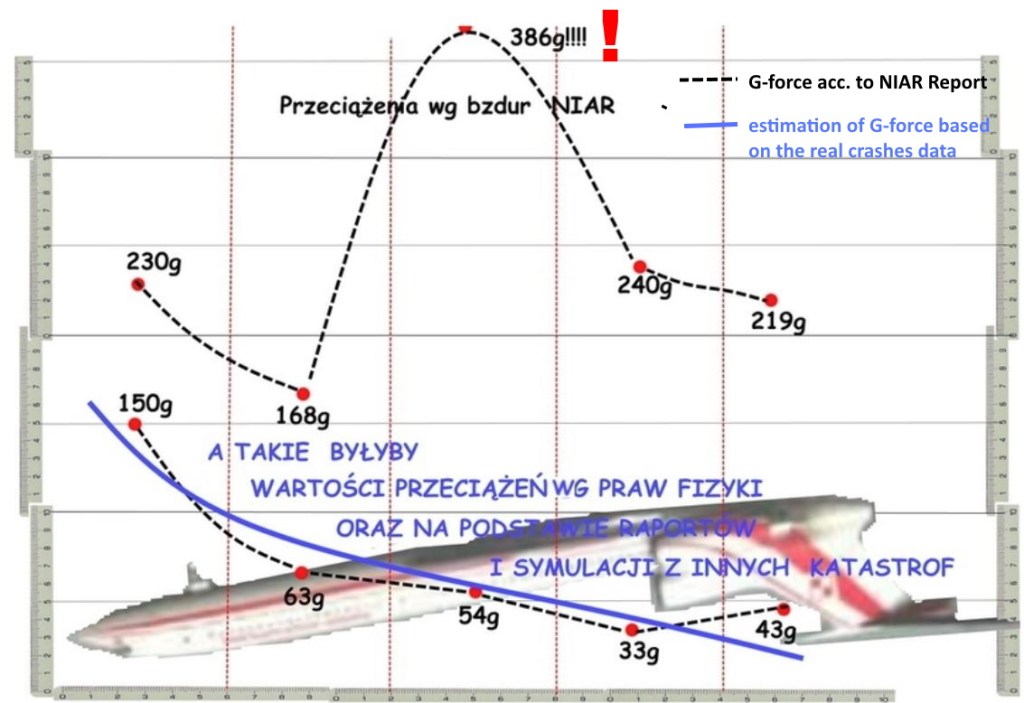
NIAR made a major error in estimating the magnitude of deceleration forces along the fuselage resulting from the aircraft’s impact with the ground. While the MAK report estimated these forces at approximately 100g, NIAR reports values as high as 386g — and this is at the floor level! However, in an inverted position, the floor would be located farther from the initial impact point, and a significant portion of the impact energy would have been absorbed in the process of crushing and tearing the fuselage structure.
It is also worth noting that in many CFIT-type crashes, the rear section of the fuselage often remains intact — including the doors, which, although difficult to open, are still operable. This implies — when translated into the language of physics and material strength — that the deceleration forces in the aft part of the fuselage did not exceed roughly 20g. This is logical and consistent with real-world experience: in the case of a long fuselage, the deceleration forces during a crash decrease progressively along its length and are lowest at the very rear — especially when the aircraft impacts the ground nose-first and at a downward angle.
hoenix Aviation Flight 702P, on a domestic flight, registered 7T-VEE, was a Boeing 737…collided with power transmission cables and a pylon during its final approach to Coventry Airport in the United Kingdom…struck the gound in inverted position…
Even if the aircraft had impacted a vertical rock wall head-on — at the same speed as in Smolensk — the deceleration forces in the rear section of the fuselage would still be significantly lower.
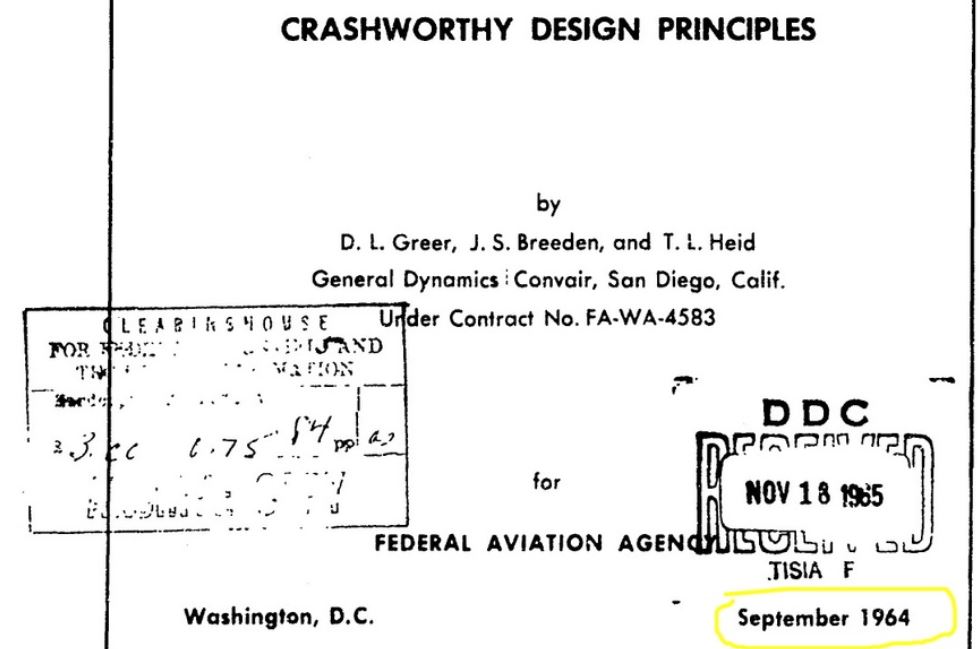
60 years ago, it was done better; people were wiser…
Strange Involvement of Professor Paweł Artymowicz in Promoting the Russian Narrative on the 2010 Smolensk Crash….
ince April 2010, a blogger known as You-know-who has been actively engaged on the Gazeta.pl forum „Katastrofa w Smoleńsku,” and later on the Salon24 platform. From the very beginning, immediately after the release of the preliminary MAK report, he uncritically supported the Russian version of the Tu-154M crash and began systematically promoting this narrative. On Salon24, he has continued for years to present the Russian interpretation as the only valid one, while simultaneously discrediting any public figures or institutions—such as the Macierewicz Commission—that question the MAK findings. He has also harshly attacked independent bloggers, including the analytical and fact-based posts of blogger quwerty.
What raises even more serious questions is his remarkable media presence: despite being an astrophysicist with no formal qualifications in crash investigation, Artymowicz was regularly invited by mainstream Polish media—such as TVN and Gazeta Wyborcza—as an „expert.” He even participated in official meetings, having been invited by MP Marcin Kierwiński to serve as an „advisor” to a parliamentary team criticizing the work of the Macierewicz subcommittee. Most strikingly, he appeared on Echo of Moscow radio, where he once again defended the MAK version while harshly criticizing alternative views—even those coming from independent Russian experts.
How did an astrophysicist without formal credentials in aviation accident analysis become such a prominent voice in the Polish media and political scene on this issue? This is a question worth asking.
One telling example of Professor Artymowicz’s questionable competence in analyzing the Smolensk crash is his comment from May 24, 2011, posted on the Gazeta.pl forum. In that entry, he tried to explain the aircraft’s final seconds of flight, claiming that the process—from the initial roll after hitting the birch tree to ground impact—would take around 10 seconds. He based this on a convoluted reasoning involving changes in vertical speed and acceleration, saying:..
„When an aircraft starts rotating and losing lift (which happens significantly only after around 4 seconds), the rate of increase of vertical velocity slows down, but the vertical velocity itself doesn’t. You then have to wait until total acceleration becomes negative, then until vertical speed falls below zero, and only then until the negative speed brings the plane close to the flat terrain… Altogether, it takes ~10 seconds before the aircraft hits the ground. Check the flight data recorder if you want to be precise. I won’t bother—I’ve already reviewed it all and found not a single physical inconsistency in the MAK narrative.„…
However, when confronted with the fact that the official MAK report describes the aircraft’s roll and impact sequence as lasting only about 5 seconds, not 10, Artymowicz was forced to backtrack. In a follow-up post dated April 29, 2011, he admitted:..
„Alright, I checked the data—turns out it was closer to 5 seconds than 10. So it was more of a quarter-barrel roll than a half-barrel roll…”
This clumsy backpedaling and vague physical reasoning—confusing first and second derivatives, and misestimating time by 100%—raises serious concerns about Artymowicz’s understanding of basic flight dynamics. Despite such errors, he has continued to present himself in media and public forums as an authoritative voice on the Smolensk crash.
rofessor Artymowicz’s 2018 RMF24 Interview: Evasive, Superficial, and Questionable
In a 2018 appearance on RMF24, Professor Paweł Artymowicz once again presented himself as an authority on the Smolensk crash. He categorically ruled out the possibility of an explosion, and claimed there was “nothing unusual” in the aircraft disintegrating into thousands of tiny fragments—a statement that contradicts known cases of CFIT (Controlled Flight Into Terrain), especially under the relatively moderate impact conditions reported.
Observers noted several disturbing aspects of his demeanor during the interview:
He frequently avoided direct eye contact, looking down or to the side,
He displayed strange gestures and smirks when asked about sensitive topics,
Most notably, he failed to address any of the central findings raised by the Polish investigative team—such as the cockpit being torn apart in mid-air or evidence suggesting pre-impact separation.
His tone was patronizing, his responses vague and devoid of technical substance. At no point did he refer to factual data or engage with counter-arguments in a serious way.
This raises a fundamental question:
Does Professor Artymowicz hold any formal accreditation or investigator certification from a recognized Canadian aviation authority, such as Transport Canada or the Transportation Safety Board of Canada (TSB), which would entitle him to speak authoritatively on aviation disasters?
To date, no evidence has surfaced confirming that Artymowicz is licensed or formally trained in accident investigation. His background is in astrophysics—a respected field, but entirely unrelated to crash forensics, materials failure, flight dynamics, or black box data analysis.
Why then has he been repeatedly promoted by certain Polish media outlets as a credible voice on one of the most complex and politically sensitive air disasters in modern Polish history?
Example 1: Fabricating Climb Rate to Fit a Predefined Trajectory.
One of the most glaring examples of data manipulation by Professor Artymowicz involves his attempt to reconstruct the final trajectory of the Tu-154M during the so-called go-around maneuver.
In order to make his version of events match the official Russian narrative, he arbitrarily assumed that the aircraft was climbing at a vertical speed of 6 meters per second at the moment it struck the birch tree—this value has no basis in recorded flight data.
In fact, according to the expert report commissioned by the Polish Prosecutor’s Office, the actual rate of climb at that critical moment was approximately 1 m/s, not six. The difference is not trivial: the entire dynamic behavior of the aircraft—altitude, trajectory, forces—depends critically on that figure.
Yet Artymowicz himself openly admitted that the value was essentially made up to fit his desired outcome. This admission becomes even more absurd when contrasted with the lofty declaration placed in the footer of his own blog:
“What I say and write will defend itself.”
Statements like this may sound confident, but they do little to conceal the fact that his calculations are based on assumptions pulled from thin air, not grounded in data or physical principles.
Example 2: Artificially Inflating Contact Area to Dismiss the Absence of an Impact Point
In order to defend the Russian MAK report, which never identified a clear impact point at the Smolensk crash site (a highly unusual omission in any aviation disaster investigation), Professor Artymowicz attempted to explain away the absence of a crater or deep ground deformation.
To do this, he grossly exaggerated the contact area between the Tu-154M fuselage and the ground. In his blog, he claimed:
“In the Smolensk case, most of the vertical kinetic energy was absorbed by deformation and breaking of the fuselage. So I estimate that 10 to 20 cm of ground indentation would be the maximum possible. The contact area might be A > 100 m², but let’s conservatively assume A ≈ 80 m², to avoid assuming that the whole fuselage hits at once. The associated mass is roughly M = 60 tons. Thanks to the high horizontal velocity, we got total fragmentation—but let’s momentarily ignore that, and just calculate the vertical deceleration effect, as if the plane struck a slippery surface reacting only to downward force.”
This line of reasoning is scientifically misleading. By inflating the contact surface area, he artificially reduces the expected depth of deformation in the soil—thus justifying the absence of any visible impact crater on the Smolensk site.
But compare this to real-world data:
In the Kamchatka crash of an Antonov An-28, a much smaller aircraft (empty weight: only 3,900 kg) collided with a hillside during approach. The slope was 30 degrees, which would disperse vertical forces more than a flat surface. And yet:
he MAK report easily identified a clear impact groove, 22 cm deep and 3.5 meters long, caused by the contact of this lightweight plane with the ground.
Now contrast that with the Tu-154M:
More than 76 tons at impact (over 19× heavier than the An-28),
Striking nearly flat terrain,
Yet no measurable crater, groove, or shear marks on the main wreckage axis.
Artymowicz’s claim—that this is somehow „normal”—ignores real comparative cases and distorts fundamental principles of impact mechanics. His assumptions serve only to validate the MAK narrative, not to explain physical reality.
Example 3: Misrepresenting Sources and Ignoring Contradictory Data
Professor Artymowicz has repeatedly claimed that the go-around trajectory he calculated is consistent with the work of Professor Janusz Kowaleczko, whose technical report from 2013—“Reconstruction of the Final Phase of Flight of TU-154M”—is publicly available. However, this is a misleading assertion on multiple levels.
First, Professor Kowaleczko himself clearly stated that calculating the full trajectory was not the objective of his analysis. As he explains in the introduction to his report, the purpose was to study the feasibility of an aerodynamic half-roll (half-barrel) maneuver after the aircraft’s contact with the birch tree—not to independently reconstruct or validate the full flight path.
In fact, the trajectory used in Kowaleczko’s study was directly adopted from the Russian MAK report, not re-derived from raw data.
Even more critically, Artymowicz ignores specific data points in Professor Kowaleczko’s report that undermine the MAK version. For example:
On one graph, Kowaleczko shows the aircraft’s speed dropping to 243 km/h at a key point in the descent,
Yet in the MAK report, the stated speed at that same point is 266 km/h—a significant discrepancy of 23 km/h.
This is not a minor detail. Such a drop in speed can drastically alter the aircraft’s ability to generate lift and complete a controlled maneuver. But Artymowicz never addresses this conflict—instead, he casually concludes:
Our results were not contradictory.”
This kind of superficial endorsement of an external report—while ignoring its stated purpose and critical data inconsistencies—reveals a pattern of confirmation bias. Artymowicz selectively references only the parts that appear to support his claims, while omitting the actual content that contradicts them.
This is not objective analysis. It is rhetorical strategy dressed as science.
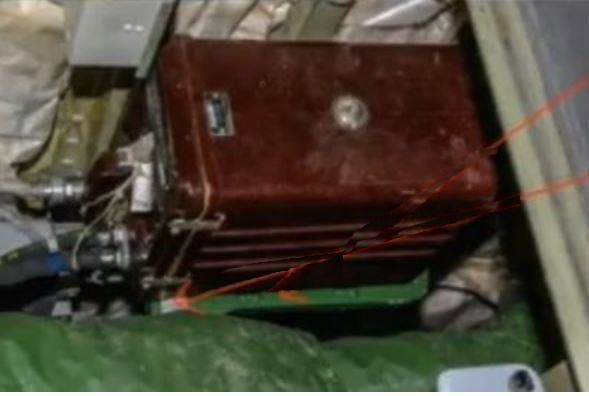
At the given in MAK Report impact parameters, the K3-63 recorder would have survived with only minor damage — especially in the case of an inverted crash, since it is mounted in a compartment in the aircraft’s floor, and such a compartment acts as an additional kind of safety cage.
I have already provided several examples of crashes with significantly more severe impact parameters, in which the K3-63 recorder survived
Such a recorder would have easily withstood a CFIT-type impact like the one described in the MAK Report… …especially considering that it actually did survive that crash!
At the impact site, a crater was formed with the following dimensions: 33.8 meters in length and 3 meters in depth.The airplane was completely destroyed, yet..Not only was the analog recorder K3-63 found, but its data was also successfully retrieved!
Although the tape was torn, the recordings of in-flight g-forces were recovered, ranging from +1.5g to –2g.
According to the MAK report, the casing of the K3-63 recorder was „not found.” .
But that is, of course, a lie — because the casing of the K3-63 recorder even survived a crash in which the aircraft impacted the ground at a speed of 950 km/h!
Crash of the Tu-124 plane nearby Dnepropetrovsk in 1970.
The impact point is the location where the aircraft’s fuselage first made contact with the ground. It is an easily identifiable trace, as it is typically the most prominent one.
– In Smolensk, no impact point was identified. – Not by the MAK. – Not by the Lasek Commission. – Not by Macierewicz’s Subcommission.
At the Smolensk crash site, the largest ground marks identified — for example in the Lasek report — were grooves in the soil at the beginning of the debris field, described as traces left by the vertical stabilizer.
If there is no impact point at the Smolensk crash site, it would imply that the Tu-154M did not hit the ground in one piece— whatever that may mean.
According to guidelines from international aviation organizations, identifying the impact point is a mandatory duty of those investigating the crash.
(This is important, among other things, for interpreting the location of aircraft debris in relation to the point of first impact, which can be crucial for determining the sequence of events during the crash.)
another example of such regulations from Mongolia
Why was this never was done?
The impact point was not identified — nor was the absence of an impact point at the crash site ever acknowledged.
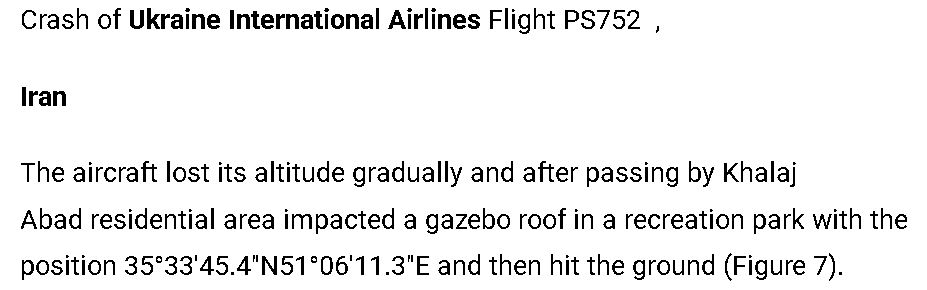
The impact with the ground created a large hole in the park.
This is a fundamental lie by MAK, announced shortly after the so-called crash and formally included in the preliminary report published in May 2010. MAK claimed that the g-forces acting on passengers at the moment of impact exceeded 100g, making survival impossible. However, as shown in many other crashes with similar parameters, the speed and angle of impact in the rear part of the aircraft cabin — or in the fuselage section near the tail — typically generate forces that do not exceed 20g!…
MAK deliberately used this falsehood — the aim was to suppress, quite successfully, any questions about the chances of survival or the lack of a rescue operation, which in this case never even took place. And yet, in many other air disasters involving similar impact parameters, there were survivors!
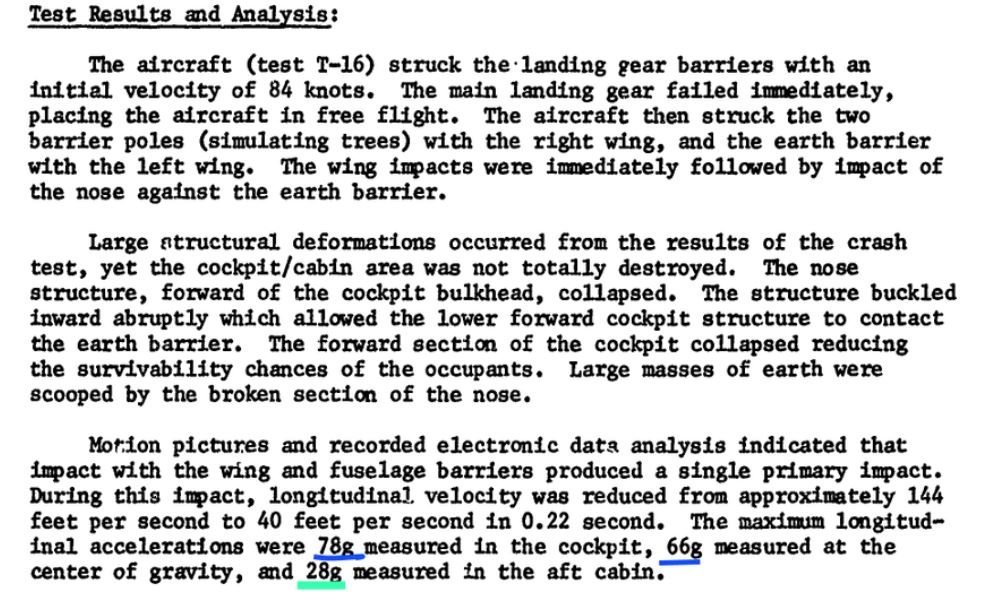
excerpt from the MAK Report:
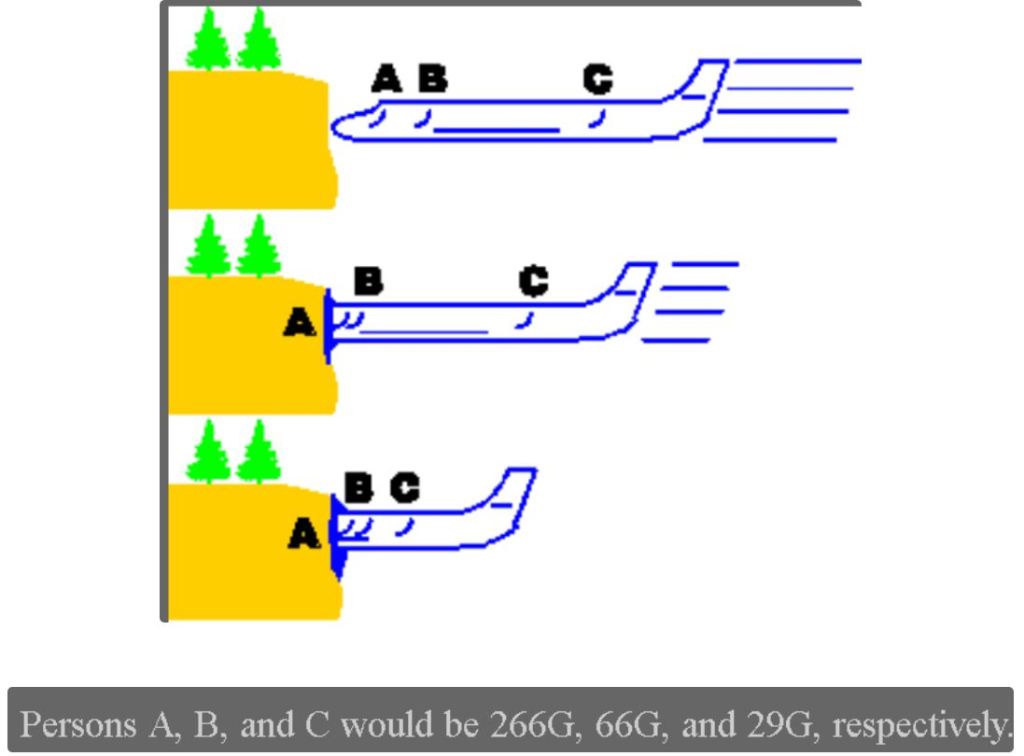
This illustrates how the g-forces decrease during an aircraft’s impact with the ground as the distance from the initial point of collision increases..
I found, for example, several CFIT-type crashes involving jet passenger aircraft at similar impact speeds, in which not only did the tail section survive largely intact—though damaged—but it was even possible, albeit with difficulty, to open the rear doors.
found, for example, several CFIT-type crashes involving jet passenger aircraft at similar impact speeds, in which not only did the tail section survive largely intact—though damaged—but it was even possible, albeit with difficulty, to open the rear doors.
This can be verified using data from, for example, the crash of the Boeing 747 in Japan.
Although the tail section of that aircraft separated in flight due to structural failure, parts of the aft fuselage were found relatively intact at the crash site, and several passengers seated near the rear survived. Reports also confirm that one of the rear doors remained in recognizable condition and could theoretically be opened, supporting the claim that the tail section can survive CFIT-type impacts at high speed
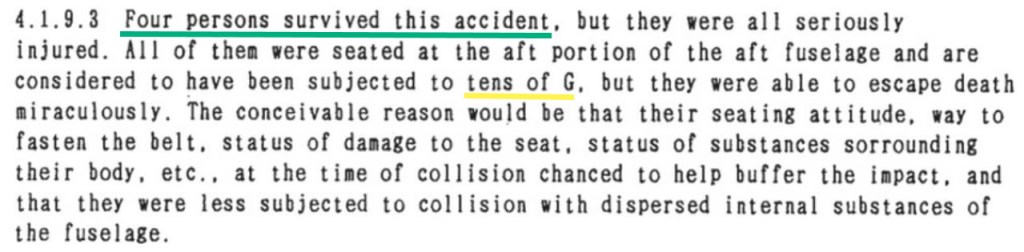
Despite such severe structural damage to the aircraft and deceleration forces on the order of several tens of g, many people survived the initial impact of the crash.,
FOR EXAMPLE – the majority of Air India passengers did not die from impact injuries, nor from forces caused by overloads, nor from being struck by aircraft fragments, but as a result of the fire.
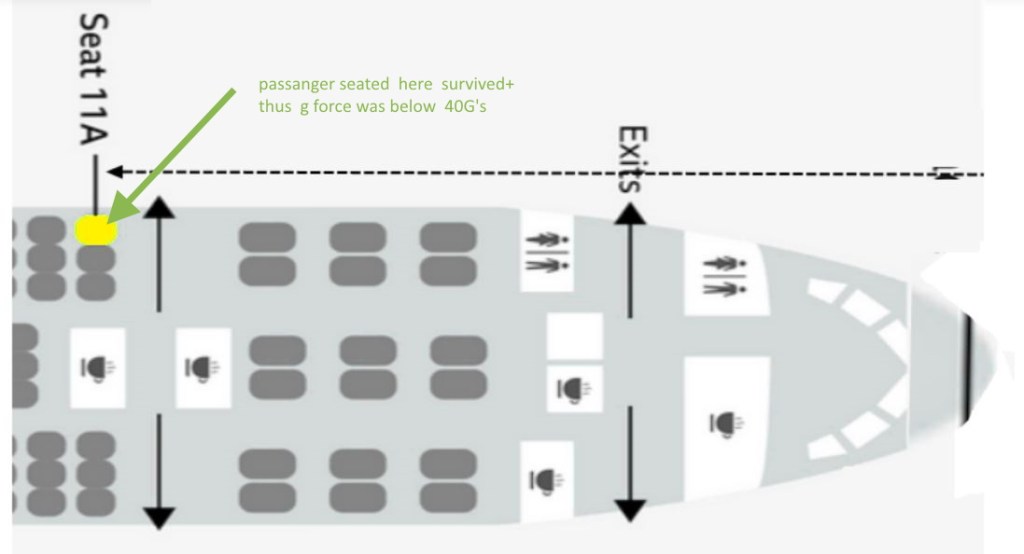
– if at a distance of 15 meters from the aircraft’s nose the local g-forces had already dropped at palce below 40g, then at the rear end of the passenger cabin they were likely in the range of just a few dozen g.
The fuselage of the Boeing 727 in Coventry after theCFIT crash in upside down position.
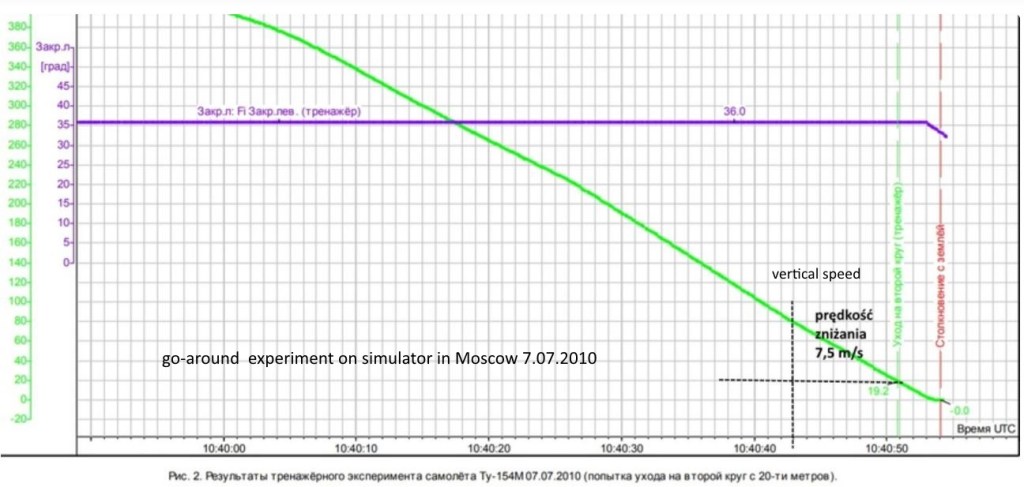
According to the MAK report, the pilots initiated the go-around maneuver at a radio altitude of 20 m, with a descent speed of approximately 7.5 m/s and with the engines operating at a level close to the minimum; according to the manual data, with such initial parameters the aircraft would have resulted in height loss about 40m. In July 2010 MAK performed the experiment on the simulator in Moscow in which they checked the possible trajectory of go-around maneuver of Tu-154M when starting maneuver with parameters as in MAK report. The result was: height loss – about 19-22m ; yet they did not revealed the engine thrust level at 0 point and the engines thrust increase rate which both are critical for go-around maneuver.. Yet, in fact the result was negative though oficially was not commented as negative..
According to the Russian manual on aerodynamics of the Tu-154 aircraft, Bechtir et al., when starting a maneuver with the engines in „low throttle” mode, the frontal drag increases faster than the thrust; as a result, the aircraft speed decreases and a pitching moment is created.. .Not only does it take about 7-8 seconds to spin up the engines from low-throttle thrust mode,
but also—even worse for the ability to transition to climb—a feature of the Tu-154M engines is that for the first 2.5 seconds of spin up, the increase in thrust is very slow… (Source: Bechtir at al- Practical Aerodynamics of the Tu-154M Aircraft)
-Boeing-727 crash report – Gatwick England https://www.webcitation.org/6EhXmwmyD?url=http://www.gatwickaviationsociety.org.uk/YA-FAR.asp At the time of initiating the go-around maneuver at an altitude of approximately 120 m, the Boeing 727 aircraft was descending at a speed of 270 km/h and had a sinking speed between 8 and 11 m/sec. (Similar parameters to Smolensk). The flaps were extended to 30 degrees. Experts performed the series of go-around maneuvers on simulator. .1.15 Tests and research
When the commander initiated recovery action the aircraft was descending at about 150 knots and 1,500 to 2,000 feet per minute. At this speed – more than 30 knots above the reference speed – it is theoretically possible for a properly executed pull-up manoeuvre to be accomplished with a height loss of as little as 55 feet. In tests on a simulator this ideal was not met and as much as 300 feet was taken to recover although this figure was reduced to 100 feet as the pilot repeated the exercise.















 Tytuł witryny