Critical remarks on the sufficiency of the energy-based argument
Dear Sir or Madam,
After reviewing NIAR’s study prepared for the Polish Subcommittee on the Tu-154M crash, I would like to submit the following technical remarks concerning the hypothesis that one of the passenger doors was driven (“embedded”) into the ground prior to the main fuselage impact.
1. Energy is necessary, but not sufficient
In your report, the conclusion that the door could have penetrated the soil is based essentially on an energy argument: that the kinetic energy available in the motion of the fuselage and its fragments would have been sufficient to drive the door into the ground to the observed depth.
While this may be true at the level of an energy budget, such a criterion is not sufficient. For penetration to occur, the following must also be satisfied:
- proper orientation of the door with respect to the velocity vector (approximately normal to the door plane),
- existence of a stiff load path capable of transmitting the impact force,
- realistic contact mechanics (penetration vs. sliding, tumbling, or bouncing),
- dynamic behaviour of the disintegrating fuselage structure.
These factors were not analysed in a way that would justify the conclusions drawn.
2. No “hammer”: a disintegrating fuselage cannot drive the door as a solid striker
The door-embedding scenario implicitly assumes that the disintegrating fuselage acts like a hammer transferring a concentrated impulse into the door.
From a structural-mechanics standpoint this is not realistic, because:
Thus, even if the total energy of motion was theoretically sufficient, there existed no structurally sound mechanism to deliver this energy to the door in the form of a focused penetration impulse.
In the area of the door, the fuselage lost its structural integrity and stiffness due to severe fragmentation.
A disintegrating shell structure cannot provide a stiff, continuous load path needed to transfer a concentrated impact force.
When the “hammer” (the surrounding structure) breaks apart, most of the energy is dissipated in its own crushing and tearing, not transmitted directionally into the door.
Mechanically, this is equivalent to trying to drive a nail with a hammer that disintegrates before it hits the nail.
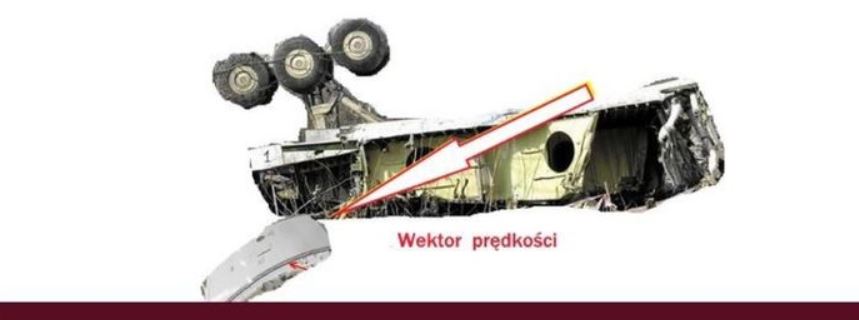
3. Incorrect or missing geometry and kinematics of the door motion
For the door to be embedded in the ground:
- the direction of its motion must be approximately perpendicular to its plane,
- the angle of impact must favour penetration and not tangential sliding or tumbling,
- the door must maintain a reasonably stable orientation shortly before contact with the soil.
However:
- reconstructed motion of the fuselage fragments indicates a highly oblique velocity vector,
- the orientation of the door within the breaking fuselage is unfavourable for penetration,
- no credible mechanism is presented that would align the door’s normal vector with the velocity vector and stabilise it prior to impact.
In practice, with such geometry the door would be expected to strike in a glancing, edge-on, or tumbling manner, leading to deformation and rotation—not deep, axial penetration.

4. Revised wording: the energetic argument
To incorporate the requested clarification:
Even if the door obtained energy sufficient to drive the door into the soil, without the proper geometry of impact there is no possibility of penetration—only bouncing, sliding, or rotational motion.
This expresses the key mechanical limitation: energy alone cannot compensate for the wrong orientation and lack of a stiff striker.
5. Observed door deformation contradicts a penetration scenario
Photographs of the door show:
- no axial crushing pattern typical of elements driven into soil under normal impact,
- deformation consistent with lateral crushing,
- absence of signatures of high-angle penetration into cohesive ground.
This contradicts the scenario of the door being driven deeply into the ground like a projectile.
6. Conclusion
The hypothesis that the Tu-154M door was embedded in the soil in the manner described by NIAR is mechanically implausible, because:
- it relies solely on a global energy argument,
- it neglects essential geometric and dynamic conditions,
- it assumes a stiff striker that did not exist (the fuselage was already breaking apart),
- it is inconsistent with the observed pattern of deformation on the actual door.
A technically sound conclusion would require a revised analysis including:
- full 3D kinematics of the door and adjacent structure,
- realistic modelling of structural fragmentation and loss of load paths,
- detailed contact mechanics between the door and soil,
- direct comparison with the observed damage to the recovered door.
Respectfully,
The Author
 Tytuł witryny
Dodaj komentarz