In the materials published by the Lasek Team, a second birch and a broken spruce appear. The problem is, there was only one airplane.
The lack of location data, contradictory photographs, and opposite directions of tree breaks clearly show that this “second birch” has nothing to do with the well-known Bodin birch.
Once again, we see how, in the Smolensk case, analysis was replaced by staging — and how the catastrophe of physics became part of the official narrative.
I. Two Different Trees – Two Different Places
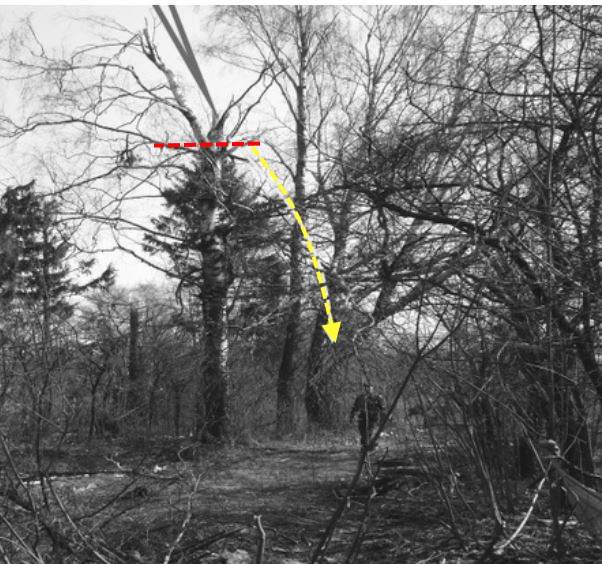
In the documentation released by Maciej Lasek’s team (KBWLLP), there is a photograph of a broken birch tree. Its exact location is not given. No coordinates. No map. Not even a clarification whether this is the same birch described by the MAK report — the famous Bodin birch.
A close comparison of photos proves that these are two different trees:
| Feature | Bodin Birch | “Second Birch” (Lasek Team) |
|---|---|---|
| Break height | About 5–6 m above ground | Similar height |
| Direction of break | Broken crown pointing upward, tree tip downward, resting on the ground | Broken crown pointing downward, tree tip upward, hanging among nearby branches |
| Position after break | Trunk driven into the ground, stable position | Trunk suspended, no ground contact |
| Surroundings | Open area near Bodin’s fence, few trees nearby | Dense grove — spruces and pines in the background |
These are objective differences. The tree shown in Lasek’s photo is not the Bodin birch — it’s another tree, in another place, never identified or mapped.
II. The Spruce and the “Second Birch” – Trees from Another Story
In the same materials, a broken spruce is visible — tall, thick, and snapped about seven meters above the ground. Thus we have three trees: the Bodin birch, the “second birch,” and the spruce.
They could not have been broken by the same aircraft.
Once the first collision occurred, the plane would have lost stability; after that, there could be no “precise hits” on further trees in the same line.
Even if those trees stood roughly along the same axis, simple logic remains: a catastrophe doesn’t happen three times in a row.
You can’t crash the same airplane three separate times.

III. No Location – No Verification
Lasek’s team had all the necessary data: aerial photographs, the MAK trajectory, digital terrain models, and high-resolution imagery. Yet they never published the coordinates of either the second birch or the spruce.
They simply failed to perform the basic verification — assigning GPS positions to the trees visible in the photos.
That’s not a lack of ability — it’s a lack of will. Because once the coordinates were known, it would become obvious that those trees stand off the actual flight path — somewhere else entirely.
IV. Reactions of Commenters – Emotion Instead of Argument
When I pointed out these inconsistencies, the response was predictable. One commenter wrote (April 29, 2023):
“You saw but understood nothing. Can you give the coordinates of the photo point and the direction of view? Do you even know what perspective is? Too difficult a word for such an ignoramus like you. Without such details, your ‘scholarly’ analysis is worth nothing — fit only for the toilet. Let’s remind ourselves, comrade conspiracist, where people keep your pseudo-scientific nonsense…”
That post received seven upvotes and one downvote. My factual, calm comment — zero upvotes and thirty downvotes.
That says it all about today’s “debate culture.” Insults get applause; observation gets punishment. But you don’t need GPS data to see that two trees with opposite directions of break are not the same tree.
V. Physics vs. Propaganda – the Catastrophe of Physics in Smolensk
From the very beginning, the greatest victim of this story has been physics itself. Not the aircraft, not the trees, but the basic law of cause and effect — replaced by rhetoric and belief.
In official narratives, gravity gives way to political convenience; aerodynamics to storytelling. The airplane continues to “fly” and “break trees” long after it should have fallen — because the scenario demands it.
That is why I have long called Smolensk not only an air disaster, but also a catastrophe of physics.
When facts contradict a theory, you don’t bend the facts — you correct the theory.
No one in the official reports dared to do that.

Author: Erevnitis Istorias
Independent researcher analyzing technical and photographic documentation of the Smolensk crash.
Founder of the blog “The Catastrophe of Physics in Smolensk” — a space where facts take precedence over belief.
 Tytuł witryny
Dodaj komentarz