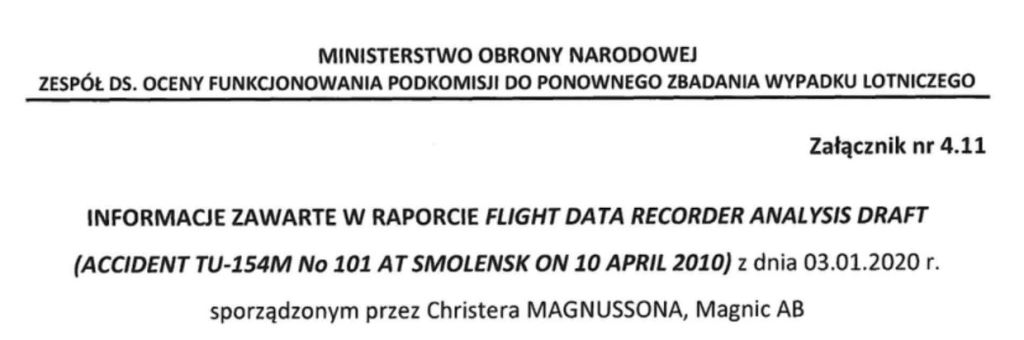
When analyzing the documentation prepared for the Polish Subcommittee on the Smolensk crash, one cannot ignore the technical mistakes made by the Swedish expert Christer Magnusson. His report, instead of clarifying key issues, introduced several inaccuracies that weaken the credibility of the findings.
The most serious problems include:
Lack of Comparative Case Studies – Other well-documented crashes with similar parameters (descent speed, angle of impact, load factors) were ignored, even though such comparisons are the foundation of professional accident investigation.
Misinterpretation of Flight Dynamics – Magnusson relied on oversimplified models of aircraft behavior, ignoring the real aerodynamic characteristics of the Tu-154M, particularly in landing configuration with flaps extended and engines at reduced thrust.
Incorrect Data Correlation – Certain numerical values, such as descent rates, thrust settings, and altitude changes, were combined in ways that contradict the official FDR data and known performance parameters of the aircraft.
Speculative Conclusions – Instead of basing his analysis on verified measurements, Magnusson drew conclusions from assumptions that were not supported by either Russian or Polish documentation.
The consequence is that Magnusson’s expertise did not strengthen the Subcommittee’s work but rather opened space for criticism, both in Poland and abroad. The credibility of any investigation depends on precision and verifiable physics, not on speculative interpretations.
This raises a serious question: why was such an analysis, marked by methodological weaknesses, accepted as part of the official investigation?

A Key Error in Christer Magnusson’s Analysis Supporting the Russian MAK Narrative.
In his report concerning the Smolensk crash, Swedish expert Christer Magnusson made a critical error when reconstructing the final trajectory of the Tu-154M. This mistake, whether intentional or not, directly supports the Russian MAK version of events.
Magnusson concluded that “during the last 3 seconds before the birch tree, the aircraft’s altitude above the slightly rising terrain remained constant at about 6.2 meters.” Later, the Polish Ministry of Defense Commission — which criticized the Subcommittee’s report and openly supported the MAK findings — echoed this claim, stating that “the expert carried out a detailed analysis of the aircraft’s trajectory.”
But here lies the problem:
If the Tu-154M had indeed flown on a flat trajectory at a constant height of about 6 meters right up to the birch tree, then after losing the wingtip it could not possibly have climbed by more than ten meters in the next seconds, while simultaneously rolling rapidly to the left – as the MAK report asserts.
Such a scenario is aerodynamically inconsistent with the aircraft’s configuration (flaps extended, landing gear down, engines at reduced thrust). The physical limitations of lift and control forces make it impossible.

By failing to recognize this contradiction, Magnusson’s “flat trajectory” analysis effectively provides indirect support to the Russian MAK narrative – a narrative that has long been criticized for its internal inconsistencies and lack of adherence to basic flight physics.
Instead of clarifying the key issue of the Tu-154M’s last seconds of flight, Magnusson’s conclusion deepens confusion and undermines the credibility of those Polish experts and institutions that chose to rely on his flawed opinion.
 Tytuł witryny
Dodaj komentarz