This is a fundamental lie by MAK, announced shortly after the so-called crash and formally included in the preliminary report published in May 2010. MAK claimed that the g-forces acting on passengers at the moment of impact exceeded 100g, making survival impossible. However, as shown in many other crashes with similar parameters, the speed and angle of impact in the rear part of the aircraft cabin — or in the fuselage section near the tail — typically generate forces that do not exceed 20g!…
MAK deliberately used this falsehood — the aim was to suppress, quite successfully, any questions about the chances of survival or the lack of a rescue operation, which in this case never even took place. And yet, in many other air disasters involving similar impact parameters, there were survivors!
excerpt from the MAK Report:

This illustrates how the g-forces decrease during an aircraft’s impact with the ground as the distance from the initial point of collision increases..

I found, for example, several CFIT-type crashes involving jet passenger aircraft at similar impact speeds,
in which not only did the tail section survive largely intact—though damaged—but it was even possible, albeit with difficulty, to open the rear doors.
found, for example, several CFIT-type crashes involving jet passenger aircraft at similar impact speeds,
in which not only did the tail section survive largely intact—though damaged—but it was even possible, albeit with difficulty, to open the rear doors.
This can be verified using data from, for example, the crash of the Boeing 747 in Japan.
Although the tail section of that aircraft separated in flight due to structural failure, parts of the aft fuselage were found relatively intact at the crash site, and several passengers seated near the rear survived. Reports also confirm that one of the rear doors remained in recognizable condition and could theoretically be opened, supporting the claim that the tail section can survive CFIT-type impacts at high speed
http://www.mlit.go.jp/jtsb/eng-air_report/JA8119.pdf
https://www.britannica.com/place/Kanto-Range


Despite such severe structural damage to the aircraft and deceleration forces on the order of several tens of g, many people survived the initial impact of the crash.,
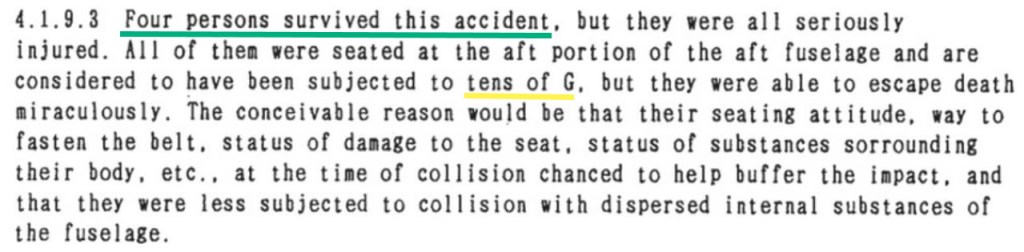
FOR EXAMPLE – the majority of Air India passengers did not die from impact injuries,
nor from forces caused by overloads,
nor from being struck by aircraft fragments,
but as a result of the fire.
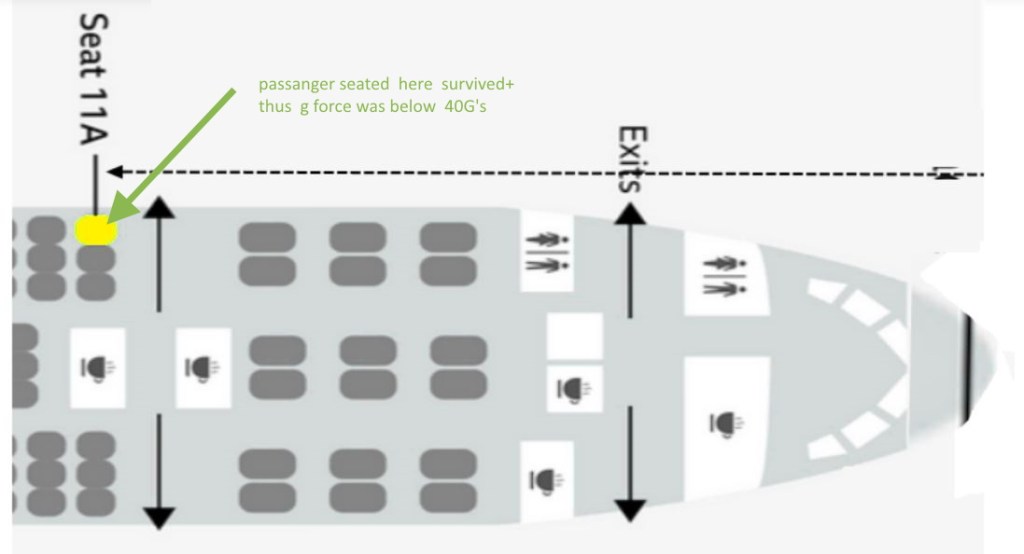
– if at a distance of 15 meters from the aircraft’s nose the local g-forces had already dropped at palce below 40g,
then at the rear end of the passenger cabin they were likely in the range of just a few dozen g.
The fuselage of the Boeing 727 in Coventry after theCFIT crash in upside down position.

 Tytuł witryny
Dodaj komentarz