
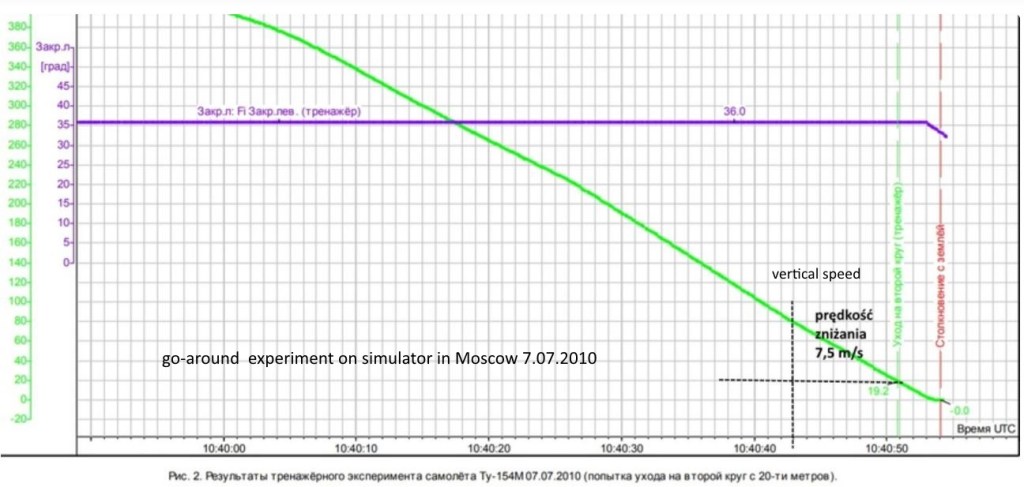
According to the MAK report, the pilots initiated the go-around maneuver at a radio altitude of 20 m, with a descent speed of approximately 7.5 m/s and with the engines operating at a level close to the minimum; according to the manual data, with such initial parameters the aircraft would have resulted in height loss about 40m. In July 2010 MAK performed the experiment on the simulator in Moscow in which they checked the possible trajectory of go-around maneuver of Tu-154M when starting maneuver with parameters as in MAK report. The result was: height loss – about 19-22m ; yet they did not revealed the engine thrust level at 0 point and the engines thrust increase rate which both are critical for go-around maneuver.. Yet, in fact the result was negative though oficially was not commented as negative..

According to the Russian manual on aerodynamics of the Tu-154 aircraft, Bechtir et al., when starting a maneuver with the engines in „low throttle” mode, the frontal drag increases faster than the thrust; as a result, the aircraft speed decreases and a pitching moment is created.. .Not only does it take about 7-8 seconds to spin up the engines from low-throttle thrust mode,
but also—even worse for the ability to transition to climb—a feature of the Tu-154M engines is that for the first 2.5 seconds of spin up, the increase in thrust is very slow… (Source: Bechtir at al- Practical Aerodynamics of the Tu-154M Aircraft)
-Boeing-727 crash report – Gatwick England https://www.webcitation.org/6EhXmwmyD?url=http://www.gatwickaviationsociety.org.uk/YA-FAR.asp At the time of initiating the go-around maneuver at an altitude of approximately 120 m, the Boeing 727 aircraft was descending at a speed of 270 km/h and had a sinking speed between 8 and 11 m/sec. (Similar parameters to Smolensk). The flaps were extended to 30 degrees.
Experts performed the series of go-around maneuvers on simulator. .1.15 Tests and research
When the commander initiated recovery action the aircraft was descending at about 150 knots and 1,500 to 2,000 feet per minute. At this speed – more than 30 knots above the reference speed – it is theoretically possible for a properly executed pull-up manoeuvre to be accomplished with a height loss of as little as 55 feet. In tests on a simulator this ideal was not met and as much as 300 feet was taken to recover although this figure was reduced to 100 feet as the pilot repeated the exercise.
 Tytuł witryny
Dodaj komentarz